Zum Inhalt springen

For information & educational purposes only — not medical advice, no dosing or usage recommendation.

Pharmacology fundamentals

Accessible basics to classify the substance profiles correctly — from “What is a peptide?” through an interactive half-life model to the question of what the regulatory status means.

1

What is a peptide?
What is a peptide?

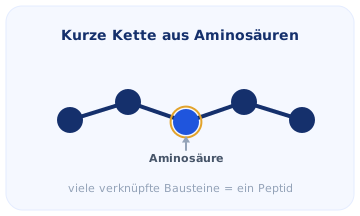
A peptide is a short chain of amino acids — the building blocks of proteins. While proteins consist of very many amino acids, peptides are considerably shorter (often from a few to a few dozen).

In the body, peptides act as hormones and signaling molecules: they bind to receptors and trigger biological responses — for example insulin (a peptide hormone) or the incretins GLP-1 and GIP.

Because many peptides are broken down quickly by enzymes in the digestive tract and blood, therapeutic peptides are often chemically modified so that they stay stable longer.
2

Agonists & incretins

Agonists & incretins

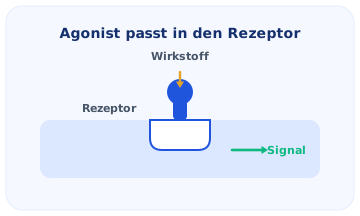
An agonist is a substance that activates a receptor and thereby triggers its signal. The counterpart is the antagonist, which blocks the receptor.

Incretins are gut hormones (e.g. GLP-1 and GIP) that promote insulin secretion in a glucose-dependent way after eating. “Incretin mimetics” imitate this effect.

Modern metabolic drugs sometimes target several receptors at once: GLP-1 alone (semaglutide), GLP-1 + GIP (tirzepatide) or GLP-1 + GIP + glucagon (retatrutide, experimental).

3

What does half-life mean?

What does half-life mean?

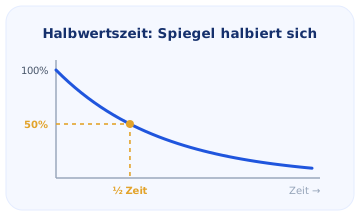
The half-life is the time in which the concentration of a substance in the body falls by half. It is a descriptive pharmacological parameter.

A long half-life (e.g. several days) allows less frequent administration; a short one means rapid breakdown. For approved medicines this gives rise to the medically determined administration schedule.

Important: in this app the half-life is purely informative knowledge. We deliberately derive no dosing or usage schedules from it — that is the task of the treating physician. The interactive model right below shows the principle with abstract units.

InteractiveModel · abstract units

Half-life & steady state to try out

Move the sliders and watch the principle at work: how a substance is broken down — and why it accumulates with repeated intake. Deliberately without a substance, without mg, without syringe units. A teaching graphic, not a calculator.

1× t½2× t½3× t½4× t½5× t½6× t½50 %25 %13 %6.3 %3.1 %Amount in the body (arbitrary units · 1 dose = 100)Time (model) — grid in multiples of the half-life

After 1× half-life

50%

After 3× half-life

12.5%

Practically eliminated

≈ 4–5× t½

Each half-life halves the amount still present: after 1× 50% remain, after 2× 25%, after 3× 12.5% — and so on. After about 4–5 half-lives a substance is practically completely broken down.

Push the half-life higher: the curve stretches over time without changing its shape. That is exactly what this parameter says — a description of the decay, not a usage schedule.

Why there is deliberately no dose or half-life calculator for real preparations here, we explain openly on:

Why no calculator? →
4

Preclinical ≠ proven in humans

Preclinical ≠ proven in humans

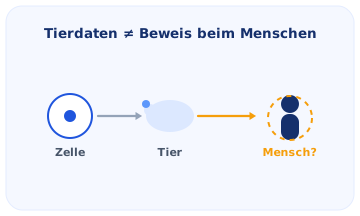
A large part of the data on popular “research peptides” comes from cell cultures (in vitro) and animal experiments (in vivo, mostly rodents). This is called preclinical research.

Promising preclinical results are a start — but they do not predict whether a substance is safe and effective in humans. Many substances that convince in animal models later fail in clinical trials.

Only controlled clinical trials (phase 1–3) and regulatory approval prove benefit and safety for human use in a defined indication.

5

Reading the regulatory status correctly

Reading the regulatory status correctly

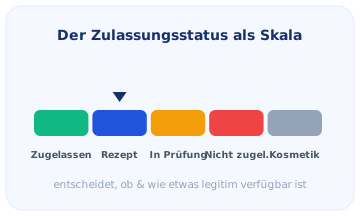
Approved / prescription-only: a tested medicine with a defined indication. Use belongs in a doctor’s hands.

Investigational: still in studies, without approval. Legitimately available only in the study context.

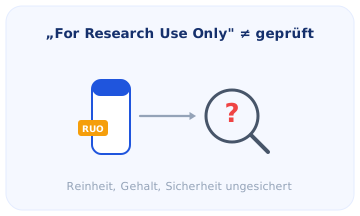
Not approved / research substance: not a medicine for human use. Online offers often use the “Research Use Only” label.

Cosmetic: used as a topical ingredient — that is not the same as approval as an injectable medicine.

6

What “For Research Use Only” really means

What “For Research Use Only” really means

“For research purposes only” is a legal label that keeps products outside medicines regulation. It is not a statement about quality, purity or safety for humans.

On the gray market this label often serves to hand out unapproved or prescription-only substances to end users, without medical oversight and without controlled manufacturing.

What is decisive, therefore, is always the actual regulatory status of the substance — not the label on the vial.

7

Reconstitution & sterility

Reconstitution & sterility

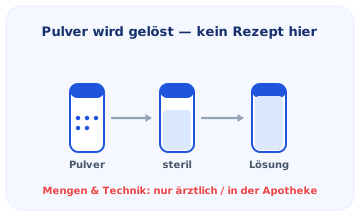
Many research peptides come as a lyophilised (freeze-dried) powder, because peptides decay quickly in dissolved form — the dry powder is more stable and can be stored longer. “Reconstitution” refers to dissolving this powder in a liquid.

Bacteriostatic water is sterile water with a small addition of a preservative (benzyl alcohol) that inhibits bacterial growth. In medicine it is used to dissolve certain injectable preparations. It is itself a regulated product — not a freely usable household remedy.

Peptides are also sensitive to temperature and light: once dissolved, they keep for only a limited time and depend on a correct cold chain. In the regular system, expiry dates and storage rules safeguard this — with anonymous gray-market purchases this information is entirely missing.

This app deliberately gives NO mixing guide: no amounts, no concentrations, no syringe units, no technique. It is a knowledge resource, not a usage resource — preparing an injectable dose is a self-administration step that does not belong here.

What sterility really means — and why a kitchen is not it

Aseptic technique, not the kitchen table

Proper preparation of injectables takes place under cleanroom/laminar-flow conditions with defined standards (e.g. USP <797>) — not on a worktop in the bathroom or kitchen.

Particles, glass shards & pyrogens

Invisible particles, tiny glass shards from ampoules or bacterial endotoxins (pyrogens) trigger fever and inflammatory reactions. “Looks clear” rules out none of this.

Repeated withdrawal as an entry point

Every repeated withdrawal from a vial is a potential contamination route. Without validated preservation and technique, germs can grow — up to local or systemic infection.

No final control

Finished medicines undergo sterility, identity and content testing. With self-mixing from gray-market powder, every single one of these checks is missing.

Why preparation belongs in the pharmacy / medical hands

Verified origin (GMP)

Approved preparations come from Good Manufacturing Practice production with a documented batch and traceability.

Identity, purity, content known

Pharmacy and manufacturer know what is in the product. With the “research” vial that is exactly what is uncertain — contamination and wrong amounts are documented.

Concentration without amateur maths

Ready-to-use dispensing or proper preparation avoids the conversion errors that have demonstrably led to overdoses with self-drawn vials.

Reporting channels & responsibility

In the regular system there are contacts, recalls and liability when problems arise. With anonymous online purchases the user alone bears the risk.

You can read more about why we also deliberately offer no calculator for this step on “Why there is no dose calculator here”.

Ready for the profiles?

Apply your knowledge to the specific substances.

To the peptide profiles →