Beginner view — everything explained simply.
Welcome to PeptidLotse
We're glad you're here. In very plain words, you'll learn what peptides are and what to keep in mind.
So what are peptides?
Picture tiny chains made of building blocks called amino acids. Chains like these are called peptides. In the body they work like little messengers: they carry news from one place to another. Some peptides are tested medicines, others are only studied in the lab.
- Peptides are short chains of amino acids
- They act like little messengers in the body
- Not every peptide is an approved medicine
What is PeptidLotse?
PeptidLotse is an honest guide through the topic of peptides. We explain and put things in context – nothing more. We sell nothing and give no instructions on how to use anything. This is only about understanding.
- We only want to explain, not sell
- No doses and no how-to tips
- Independent and as honest as possible
What you'll find in every profile
There is a profile for each peptide. It tells you honestly what the substance is, whether it's allowed or an approved medicine, and what risks exist. Things the internet hypes as miracles, we show as a claim – not as a proven fact.
- What the substance is, in plain words
- Its legal status: allowed or not
- What risks and open questions exist
Take your time to look around
Browse through the peptides and read the page about safety and risks. It matters and helps you get a good feel for the topic. For health questions, a doctor is always the best place to turn.
The most important thing in one sentence
PeptidLotse explains peptides to you honestly and simply, sells nothing and replaces no conversation with a doctor – we just help you understand the topic better.
Find your way around PeptidLotse
Five ways into the content — pick what interests you right now.

Explore by goal
Peptides grouped by area — from metabolism to longevity.
Open
Guides & knowledge
Clear explainers on longevity, hormones and biohacking.
Open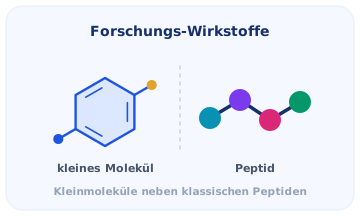
Research compounds
Non-peptide molecules (small molecules) with their own profiles.
Open
Research updates
Dated assessments of current studies and approvals.
Open
New & updated
What's been added recently — at a glance.
OpenUnderstand peptides — scientific, honest, in context.
An educational resource on common peptides: how they work, what the research actually shows, their legal status and the risks involved. Deliberately without dosing, reconstitution or injection instructions.

What are peptides?
Short chains of amino acids that act in the body as hormones and signaling molecules. Some are approved medicines, others purely research substances.
What this app does
It explains mechanisms of action, classifies regulatory status honestly and links to primary sources (PubMed, ClinicalTrials.gov, EMA, FDA).
What it deliberately avoids
No dosing, no reconstitution or injection instructions, no “protocols”. Decisions about use belong in a doctor’s hands.
Find your way around PeptidLotse
Five ways into the content — pick what interests you right now.
Explore by goal
Peptides grouped by area — from metabolism to longevity.
OpenGuides & knowledge
Clear explainers on longevity, hormones and biohacking.
OpenResearch compounds
Non-peptide molecules (small molecules) with their own profiles.
OpenResearch updates
Dated assessments of current studies and approvals.
OpenNew & updated
What's been added recently — at a glance.
OpenWhat you can rely on
Regulatory status at a glance
Every profile is clearly labeled. The status is the most important information — it determines whether and how a substance is even legitimately available.
Regulatory ticker
Sourced updates from authorities on peptide drugs — with citation, most recent first.
- ApprovalUSA
FDA: new cardiovascular indication for tirzepatide (Mounjaro) — the EMA does not (yet) follow
On 28 Aug 2026 the FDA approved an indication for tirzepatide (Mounjaro, a dual GIP/GLP-1 agonist) to reduce the risk of major adverse cardiovascular events in adults with type-2 diabetes and established cardiovascular disease — based on the SURPASS-CVOT trial (about 13,300 participants). Context: the result was non-inferiority versus the comparator dulaglutide, not superiority over placebo. The EMA's CHMP in June 2026 did NOT recommend a matching EU indication; there the data only enter the product information.
FDA / Eli LillySource - SafetyUSA
FDA warning letter to a grey-market peptide seller
On 24 Aug 2026 the FDA sent a warning letter to an online peptide seller (Royal Peptides LLC) over unapproved, misbranded products — naming among others tirzepatide, semaglutide, retatrutide, elamipretide (SS-31), PT-141 and tesamorelin. Despite a "research use only" label, the agency treats the products — through their marketing and a supplied injection kit — as de facto intended for human use. Per the FDA, injectable products of unknown purity carry serious health risks.
FDA (CDER)Source - RegulationUSA
FDA advisory committee reviews seven "wellness" peptides for compounding
On 23–24 Jul 2026 the FDA's Pharmacy Compounding Advisory Committee (PCAC) discussed seven unapproved peptides — BPC-157, KPV, TB-500, MOTS-c, DSIP (emideltide), Semax and epitalon — for possible inclusion on the §503A compounding list. It was a discussion by an advisory committee — not an approval and no proof of efficacy or safety; robust controlled human data for these substances are still lacking.
FDASource - ApprovalEU
EU Commission approves the oral Wegovy tablet (oral semaglutide)
On 16 Jul 2026 the European Commission granted EU-wide approval of the oral Wegovy tablet (oral semaglutide) for weight management in adults with obesity, or overweight with at least one weight-related condition — per the manufacturer the first oral GLP-1 receptor agonist in tablet form for weight management in the EU. It followed the positive CHMP opinion of May 2026; in the US this form had already been approved in late 2025.
Europäische Kommission / Novo NordiskSource - ApprovalUSA
FDA approves enlicitide (Lipfendra) — first oral PCSK9 inhibitor (a peptide)
On 16 July 2026 the FDA approved Merck's enlicitide (brand name Lipfendra) — per the manufacturer, the first orally available PCSK9 inhibitor to lower LDL cholesterol. The active substance is a macrocyclic peptide; the approval rests on the phase-3 CORALreef programme.
FDA / MerckSource - ApprovalUSA
FDA expands setmelanotide (Imcivree) to acquired hypothalamic obesity
On 19 March 2026 the FDA expanded setmelanotide to acquired (non-genetic) hypothalamic obesity from age 4 — the first approved therapy for this form, which follows damage to the hypothalamus. It rests on the phase-3 TRANSCEND trial; earlier approvals covered only genetic forms.
FDA / HealioSource - RegulationGlobal
WADA Prohibited List 2026: peptide hormones remain banned in sport
Under the World Anti-Doping Agency's list effective 1 January 2026, peptide hormones, growth factors and related substances in class S2 remain banned in sport. Newly added as an example is pegmolesatide (an EPO-mimetic); cell components such as mitochondria were also explicitly brought under the ban on gene and cell doping.
WADA / USADASource - ApprovalUSA
FDA approves oral Wegovy tablet — first oral GLP-1 for weight management
On 22 December 2025 the FDA approved Novo Nordisk's oral Wegovy tablet (oral semaglutide) — for long-term weight reduction and to lower the risk of major cardiovascular events. Per the manufacturer, it is the first orally available GLP-1 receptor agonist approved for weight management (based on the phase-3 OASIS 4 trial).
FDA / Novo NordiskSource - ApprovalUSA
FDA grants accelerated approval of elamipretide (Forzinity) for Barth syndrome
On 19 September 2025 the FDA granted accelerated approval of the mitochondria-targeting peptide elamipretide (SS-31) as Forzinity for the rare, genetic Barth syndrome — the first US therapy for it (Stealth BioTherapeutics). Under accelerated approval, continued approval may depend on a confirmatory trial.
FDA / StealthSource - SafetyEU
EMA: NAION classified as a very rare side effect of semaglutide
The EMA's PRAC safety committee classified the rare optic-nerve circulatory disorder NAION as a very rare side effect of semaglutide medicines (Ozempic, Rybelsus, Wegovy). Product information is being updated accordingly.
EMASource - ApprovalEU
EMA assesses tirzepatide (Mounjaro) for obstructive sleep apnoea
The EMA assessed the use of tirzepatide (Mounjaro) in moderate-to-severe obstructive sleep apnoea associated with obesity — an example of how an approved medicine's authorised uses expand over time.
EMASource - RegulationUSA
FDA: end of GLP-1 shortages limits mass compounding
After the FDA declared the semaglutide and tirzepatide shortages resolved, the transition windows for compounding these substances expired in 2025. The FDA also continually evaluates which bulk substances are permissible under §503A at all.
FDASource
A curated selection of sourced updates — not a complete overview and not legal advice.
Substance profiles
58 peptides — fact-based and clearly sourced.
Semaglutid
Metabolism & Weight
GLP-1 receptor agonist — approved, prescription-only.
Also known as: Ozempic, Wegovy, Rybelsus
View profileTirzepatid
Metabolism & Weight
Dual GIP/GLP-1 receptor agonist — approved, prescription-only.
Also known as: Mounjaro, Zepbound
View profileRetatrutid
Metabolism & Weight
Triple agonist (GIP/GLP-1/glucagon) — in clinical testing, NOT approved.
Also known as: LY3437943
View profileBPC-157
Tissue & Regeneration
Synthetic peptide — predominantly animal data, NOT approved for humans.
Also known as: Body Protection Compound 157, PL 14736 (verwandt)
View profileTB-500 / Thymosin β4
Tissue & Regeneration
Actin-binding peptide — research substance, NOT approved.
Also known as: TB-500, Thymosin Beta-4, Tβ4
View profileGHK-Cu
Skin & Cosmetics
Copper-binding tripeptide — established in topical cosmetics.
Also known as: Kupfer-Tripeptid-1, Copper Peptide, Glycyl-L-Histidyl-L-Lysin:Cu
View profileCJC-1295 + Ipamorelin
Growth Hormone System
Growth hormone secretagogues — research peptides, not approved for humans.
Also known as: Modified GRF (1-29), GHRH-Analogon + GHRP, Ipamorelin
View profileAOD-9604
Metabolism & Weight
HGH fragment — clinically investigated, but not approved as a weight-loss medication.
Also known as: HGH-Fragment 176-191, Anti-Obesity Drug 9604
View profileTesamorelin
Metabolism & Weight
GHRH analogue — approved prescription-only in the USA (HIV lipodystrophy).
Also known as: Egrifta
View profileSemax
Cognition & Neuro
Neuropeptide — registered as a medicine in Russia, not approved in the EU/USA.
Also known as: ACTH(4-7)-Analogon, Heptapeptid
View profileSelank
Cognition & Neuro
Anxiolytic neuropeptide (tuftsin analogue) — registered in Russia, not approved in the EU/USA.
Also known as: TP-7, Tuftsin-Analogon
View profileArgireline (Acetyl Hexapeptide-8)
Skin & Cosmetics
Cosmetic peptide — topical in anti-aging formulations.
Also known as: Acetyl Hexapeptide-3, Acetyl Hexapeptide-8
View profileMatrixyl (Palmitoyl-Peptide)
Skin & Cosmetics
Cosmetic matrikines — topical to stimulate collagen formation.
Also known as: Palmitoyl Pentapeptide-4, Palmitoyl Tripeptide-1, Palmitoyl Tetrapeptide-7
View profileEpitalon (Epithalon)
Longevity & Immune System
Synthetic tetrapeptide — research substance for aging, not approved.
Also known as: Epithalon, AEDG, Ala-Glu-Asp-Gly
View profileThymosin Alpha-1 (TA-1)
Longevity & Immune System
Immunomodulating peptide — approved as Zadaxin in several countries, not FDA-approved.
Also known as: Tα1, Zadaxin, Thymalfasin
View profileSermorelin
Growth Hormone System
GHRH analogue — was approved as Geref, today no approved finished medicinal product.
Also known as: Geref, GHRH (1-29), Sermorelin-Acetat
View profileGHRP-2
Growth Hormone System
Synthetic ghrelin mimetic — traded as a research substance, banned in sport.
Also known as: Pralmorelin, KP-102, Growth Hormone Releasing Peptide-2
View profileGHRP-6
Growth Hormone System
The first GH-releasing peptide — a strong appetite trigger, not approved.
Also known as: Growth Hormone Releasing Peptide-6, SKF-110679
View profileHexarelin
Growth Hormone System
The strongest GH releaser of the GHRP group — with desensitization and cardiac research.
Also known as: Examorelin, HEX
View profileSomatropin (HGH 191AA)
Growth Hormone System
The real recombinant growth hormone — approved, prescription-only, banned in sport.
Also known as: rhGH, Genotropin, Norditropin
View profilePT-141 (Bremelanotid)
Melanocortin System
Melanocortin agonist for sexual desire — approved in the USA as Vyleesi.
Also known as: Bremelanotid, Vyleesi, PT-141
View profileMelanotan II
Melanocortin System
A tanning peptide without approval — with documented melanoma and priapism cases.
Also known as: MT-II, MT-2
View profileMelanotan I (Afamelanotid)
Melanocortin System
Approved as an implant (Scenesse) — but only for the rare light disease EPP, not for tanning.
Also known as: Afamelanotid, Scenesse, MT-1
View profileMOTS-c
Longevity & Immune System
A mitochondrially encoded peptide — an "exercise mimetic" of research, not approved.
Also known as: MOTSc, Mitochondrial ORF of the 12S rRNA type-c
View profileSS-31 (Elamipretid)
Longevity & Immune System
A cardiolipin-stabilizing mitochondrial peptide — approved in the USA for Barth syndrome in 2025.
Also known as: Elamipretid, Bendavia, MTP-131
View profile5-Amino-1MQ
Metabolism & Weight
Not a peptide but an NNMT inhibitor — fat-metabolism research without human data.
Also known as: 5-Amino-1-Methylquinolinium, NNMT-Inhibitor
View profileKPV
Tissue & Regeneration
An anti-inflammatory tripeptide from the α-MSH terminus — gut and research focus, not approved.
Also known as: Lysin-Prolin-Valin, α-MSH(11-13)
View profileDSIP
Cognition & Neuro
A neuropeptide with contradictory sleep evidence — not approved.
Also known as: Delta Sleep-Inducing Peptide, Delta-Schlaf-induzierendes Peptid
View profileLL-37 (Cathelicidin)
Longevity & Immune system
Endogenous antimicrobial peptide of the innate immune defense — experimental, not approved as a medicine.
Also known as: Cathelicidin LL-37, hCAP18/LL-37, CAMP
View profileFollistatin
Pure research compound
Endogenous myostatin and activin inhibitor from muscle research — experimental, not approved as a medicine
Also known as: Follistatin, FST, FS
View profileHumanin
Longevity & Immune system
Mitochondria-derived 24-amino-acid peptide from neuro- and longevity research — experimental, not approved.
Also known as: HN, Humanin (HN), HNG (S14G-Humanin, Analogon)
View profileVIP (Vasoaktives Intestinales Peptid)
Longevity & Immune system
Endogenous 28-amino-acid neuropeptide with immunomodulatory action — as the drug aviptadil it is in clinical testing, not broadly approved
Also known as: VIP, Vasoaktives Intestinales Peptid, Vasoaktives intestinales Polypeptid
View profileKisspeptin
Pure research compound
Reproductive neuropeptide of the GnRH axis — subject of clinical research, not approved.
Also known as: Kisspeptin-54, Kisspeptin-10, KP-54
View profileLiraglutid
Metabolism & Weight
Approved, prescription-only GLP-1 receptor agonist for type 2 diabetes and obesity – a predecessor of semaglutide and not a substance for self-administration.
Also known as: Victoza, Saxenda, Liraglutide
View profileDulaglutid
Metabolism & Weight
Long-acting GLP-1 receptor agonist (Fc fusion protein), once weekly – an approved prescription diabetes medication.
Also known as: Trulicity, LY2189265, Dulaglutide
View profileExenatid
Metabolism & Weight
Synthetic exendin-4: the first approved GLP-1 receptor agonist — originally derived from the saliva of the Gila monster.
Also known as: Byetta, Bydureon, Bydureon BCise
View profileCagrilintid
Metabolism & Weight
Long-acting amylin analogue in clinical investigation for weight regulation – not approved.
Also known as: Cagrilintide, AM833, NNC0174-0833
View profileSurvodutid
Metabolism & Weight
Experimental dual GLP-1/glucagon receptor agonist – in clinical trials for obesity and MASH, not approved anywhere.
Also known as: BI 456906, Survodutide (INN)
View profileMazdutid
Metabolism & Weight
Dual GLP-1/glucagon receptor agonist (oxyntomodulin analog), approved in China, under investigation elsewhere
Also known as: Mazdutide, IBI362, LY3305677
View profileSetmelanotid
Melanocortin system
Approved MC4R agonist for narrowly defined rare forms of obesity — genetic forms plus (in the US since 03/2026) the acquired hypothalamic form; not a general weight-loss drug.
Also known as: Imcivree, RM-493, BIM-22493
View profilePentadeca Arginate (PDA)
Tissue & Regeneration
Heavily hyped "next-gen BPC-157" – almost no human data, no PDA-specific studies, not approved as a medicine.
Also known as: PDA, Pentadecapeptid-Arginat, BPC-157 Arginat
View profileARA-290 (Cibinetide)
Tissue & Regeneration
Non-erythropoietic EPO derivative being investigated in early clinical trials as an agonist of the "innate repair receptor" against neuropathic symptoms.
Also known as: Cibinetide, ARA290, ARA 290
View profileIpamorelin
Growth hormone system
Selective growth hormone secretagogue — research peptide, never approved as a medicine.
Also known as: NNC 26-0161, Ipamorelin-Pentapeptid, selektives GH-Sekretagogum (GHRP)
View profileIGF-1 LR3
Growth hormone system
Makes it clear: IGF-1 LR3 is a laboratory/research reagent, not a medicine approved for humans – with serious, genuinely documented risks (including hypoglycaemia) and banned in sport.
Also known as: Long R3 IGF-1, LongR3 IGF-I, Long R3 IGF-I
View profileCerebrolysin
Cognition & Neuro
Peptide mixture derived from porcine brain with neurotrophic marketing claims – evidence inconsistent according to Cochrane.
Also known as: FPF-1070, FPF 1070, Cerebrolysinum
View profileThymalin
Longevity & Immune System
A peptide fraction derived from the thymus gland, studied primarily by Russian research groups (Khavinson) as an immunomodulator and "geroprotector" – with only limited independent confirmation.
Also known as: Thymalin, Thymus-Peptidfraktion, Thymus-Peptidpräparat
View profileGDF-11
Longevity & Immune System
A controversially debated growth factor from anti-aging research – made famous by "young blood" studies whose findings were later scientifically contested. Not an approved agent.
Also known as: Growth Differentiation Factor 11, GDF11, BMP-11
View profileOxytocin
Endocrine & reproduction
Nine-residue posterior-pituitary hormone: an approved obstetric medicine — separately marketed as an intranasal "cuddle hormone" (mixed evidence).
Also known as: Oxt, OXT, Syntocinon
View profileGonadorelin
Endocrine & reproduction
Synthetic GnRH/LHRH – the hypothalamic releasing hormone that prompts the pituitary to secrete LH and FSH.
Also known as: GnRH, LHRH, Gonadotropin-Releasing-Hormon
View profileAmycretin
Stoffwechsel & Gewicht
Experimenteller GLP-1- und Amylin-Rezeptoragonist in einem einzigen Molekül - Phase 3, nicht zugelassen.
Also known as: NN9487, NNC0487-0111, Amycretin (Novo Nordisk)
View profileEnlicitid decanoate
Stoffwechsel & Gewicht
Erster oraler PCSK9-Hemmer als Tablette – makrozyklisches Peptid zur LDL-Cholesterin-Senkung.
Also known as: Lipfendra, MK-0616, Enlicitide decanoate
View profileMaridebart cafraglutid
Stoffwechsel & Gewicht
Monatlicher Studienwirkstoff von Amgen gegen Adipositas — GLP-1-Agonismus plus GIP-Rezeptor-Blockade, noch ohne Zulassung.
Also known as: MariTide, AMG 133, Maridebart cafraglutide
View profileVK2735
Stoffwechsel & Gewicht
Der prominenteste Tirzepatid-Herausforderer außerhalb von Lilly und Novo – dual auf GLP-1 und GIP, in Phase 3, aber noch nirgends zugelassen.
Also known as: VK2735, VK-2735
View profilePalopegteriparatid
Hormonsystem & Fortpflanzung
Langwirksames Parathormon-Prodrug – erste zugelassene Ersatztherapie beim chronischen Hypoparathyreoidismus des Erwachsenen.
Also known as: Yorvipath, TransCon PTH, Palopegteriparatide
View profilePemvidutid
Stoffwechsel & Gewicht
Untersuchter, balancierter Glukagon-/GLP-1-Doppelagonist mit Schwerpunkt Leber (MASH) – nicht zugelassen.
Also known as: Pemvidutide, ALT-801, ALT801
View profileCagriSema
Stoffwechsel & Gewicht
Fixkombination aus zwei injizierbaren Peptiden — dem Amylin-Analogon Cagrilintid und dem GLP-1-Agonisten Semaglutid — zur Gewichtsreduktion; Phase 3 abgeschlossen, Zulassungsantrag eingereicht, noch nicht zugelassen.
Also known as: Cagrilintid/Semaglutid-Fixkombination, Cagrilintide/Semaglutide, CagriSema (Novo Nordisk)
View profileApraglutid
Hormonsystem & Fortpflanzung
Langwirksames GLP-2-Analog in der Prüfphase – untersucht beim Kurzdarmsyndrom, mit nur wöchentlicher Gabe, aber (Stand August 2026) nirgends zugelassen.
Also known as: FE 203799, Apraglutide, GlyPharma GLP-2-Analog
View profilePetrelintid
Stoffwechsel & Gewicht
Langwirksamer Amylin-Analog in Phase 3 – zweistelliger Gewichtsverlust bei nahezu placeboähnlicher Magen-Darm-Verträglichkeit (nicht zugelassen).
Also known as: Petrelintide, ZP8396, Petrelintid (Roche/Zealand)
View profileGuides
Background and context on longevity, compounds and peptides — independently researched and backed by primary sources. We explain and contextualize; we do not give dosing or usage recommendations.
Longevity explained simply: healthspan, the "Hallmarks of Aging" and why research is being done
What "longevity" really means - the distinction between lifespan and healthspan, the biological hallmarks of aging, and why compounds and peptides are being researched, soberly framed and without hype.
What Is Biohacking? A Sober Assessment
Biohacking ranges from harmless lifestyle tuning to risky self-experiments. This beginner's guide honestly situates the term, the evidence and the limits.
Lifespan vs. Healthspan: Why Longevity Means More Than Just "Living Longer"
A longer lifespan does not automatically mean more healthy years. What "healthspan" and "compression of morbidity" mean - and why these terms lie at the heart of the interest in longevity.
“For Research Use Only” is not safety.
That label bypasses medicines regulation — it makes a substance neither tested nor safe. Read what the gray market really means and what the legitimate clinical route looks like.