Beginner view — everything explained simply.
Machine-assisted translation — the German original version is authoritative.

Metabolism & Weight
Survodutid
BI 456906 · Survodutide (INN)
Survodutide (development code BI 456906) is a dual receptor agonist in clinical development that simultaneously activates the GLP-1 receptor and the glucagon receptor (GCGR). It is being developed by Boehringer Ingelheim in collaboration with Zealand Pharma, and is being studied primarily in obesity/overweight as well as in metabolic dysfunction-associated steatohepatitis (MASH, formerly NASH). Phase 2 results in obesity (Lancet Diabetes & Endocrinology, 2024) and in MASH with liver fibrosis (New England Journal of Medicine, 2024) have been published; a Phase 3 program (SYNCHRONIZE) is ongoing. As of 2026, survodutide is not approved as a medicinal product in any region. Efficacy and safety data derive from clinical trials and have not yet been conclusively evaluated. This profile serves information and education purposes only and is not a guide to use, dosing or acquisition.
Regulatory status
In clinical trials only · not approved
Survodutide is in clinical trials (Phase 3) and, as of 2026, is not approved as a medicinal product in any region.
Drug class
Dual incretin/glucagon receptor agonist: GLP-1 receptor and glucagon receptor (GCGR) dual agonist (peptide therapeutic).
Half-life (informative)
Survodutide is designed for once-weekly subcutaneous administration in studies, which points to a correspondingly long duration of action. Precise pharmacokinetic half-life values are deliberately not presented here as a usage instruction; they derive from clinical trials and are not a dosing recommendation.
Studied in the literature
In the clinical trials, survodutide was studied as a subcutaneous injection, usually with a stepwise dose escalation over several weeks under medical supervision within the study setting. This describes only HOW the substance was studied in trials – it is expressly not an instruction for use and not a call to self-administration.
Mechanism of action
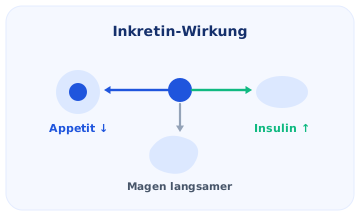
Survodutide binds and activates two receptors at once: the GLP-1 receptor and the glucagon receptor (GCGR). Via the GLP-1 receptor – analogous to pure GLP-1 receptor agonists – appetite and food intake are dampened and gastric emptying is slowed. Via the glucagon receptor, energy expenditure is additionally thought to be influenced and hepatic fat and energy metabolism (including lipolysis, glycogenolysis, gluconeogenesis) addressed. The research hypothesis is that this dual approach could be more effective in obesity and especially in MASH than GLP-1 receptor stimulation alone. These mechanisms are in part derived from animal and in vitro studies; their clinical significance in humans is being investigated in ongoing trials and has not been conclusively established.
All pharmacological information is based on ongoing or completed clinical trials and specialist publications. Because survodutide is not approved, there is no regulatory-reviewed prescribing information (e.g. EMA/FDA product information) on use, dosing or safety for general use.
Research history
Survodutide (BI 456906) is being developed by Boehringer Ingelheim together with the Danish company Zealand Pharma. After preclinical work and early clinical phases, two pivotal Phase 2 studies were published in 2024: a randomized, double-blind, placebo-controlled dose-finding trial in overweight/obesity (le Roux et al., Lancet Diabetes & Endocrinology 2024) and a Phase 2 study in MASH with liver fibrosis (Sanyal et al., New England Journal of Medicine 2024). The global Phase 3 program SYNCHRONIZE was subsequently launched, encompassing obesity with and without type 2 diabetes as well as a cardiovascular safety trial (CVOT), among others.
Positive aspects
What the research shows that is promising
Research areas
- Obesity / overweight (Phase 2 completed, Phase 3 program SYNCHRONIZE ongoing)
- Metabolic dysfunction-associated steatohepatitis (MASH/NASH) with liver fibrosis (Phase 2 published)
- Overweight/obesity in type 2 diabetes (Phase 3, SYNCHRONIZE-2)
- Cardiovascular safety in overweight/obesity (Phase 3 CVOT)
- Accompanying effects on metabolic parameters (e.g. blood pressure as a post-hoc analysis of the Phase 2 obesity trial)
Documented effects (from the literature)
- Gastrointestinal complaints were the most common adverse events in the Phase 2 trials, especially nausea, vomiting and diarrhea – typical of this drug class.
- Tolerability in the obesity trial was overall described as similar to that of GLP-1 receptor agonists.
- Gastrointestinal side effects in the trials occurred in a dose-dependent manner and more frequently than under placebo; a stepwise dose escalation was used in the study design to improve tolerability.
Risk analysis
What to view critically and honestly
Regulatory status by region
No approval by the European Medicines Agency (EMA). Survodutide is solely the subject of clinical trials.
No approval by the US authority FDA. Several Phase 3 trials are registered on ClinicalTrials.gov (e.g. NCT06066515, NCT06077864).
Not available as a medication in any country. Outside of controlled clinical trials there is no legal, vetted therapeutic use.
Safety concerns & caution
- The available data derive predominantly from Phase 2 trials; the safety and efficacy profile is only maturing with the ongoing Phase 3 data (including the cardiovascular safety trial).
- Long-term safety and rare risks in humans are not yet conclusively known.
- The additional glucagon receptor activation can influence glucose and energy metabolism; its clinical relevance is being investigated further.
- Without regulatory approval there is no reviewed prescribing information that users or treating clinicians could rely on outside of trials.
Risks of gray-market purchase
- Preparations offered on the gray market as a "research chemical" or "research vial" are not approved, not tested and can vary greatly in identity, purity, content and sterility.
- Marketing claims about "fat burning", "liver de-fatting" or superior efficacy compared to other substances are assertions from marketing or preliminary studies – not established facts for general use.
- There is no reputable, legal source for self-administration; corresponding offers carry considerable health and legal risks.
- Contaminated or mislabeled vials may contain toxic constituents, incorrect amounts of active ingredient or endotoxins.
Frequently asked questions
Is survodutide already approved as a medication?
No. As of 2026, survodutide (BI 456906) is not approved in any region – neither by the EMA in the EU nor by the FDA in the USA. It is in clinical trials (Phase 3). All data derive from studies and have not been conclusively evaluated.
How does survodutide differ from a pure GLP-1 agonist?
Survodutide activates not only the GLP-1 receptor but additionally the glucagon receptor (GCGR). The research hypothesis is that this dual action, alongside appetite suppression, also addresses energy expenditure and liver metabolism. Whether this actually confers advantages in humans is being investigated in ongoing trials and has not yet been conclusively established.
What is survodutide being studied for in trials?
Primarily for overweight/obesity and for metabolic dysfunction-associated steatohepatitis (MASH/NASH) with liver fibrosis. Phase 2 results in both areas were published in 2024; a Phase 3 program (SYNCHRONIZE) – including a cardiovascular safety trial – is ongoing.
Which side effects were observed in the trials?
Most commonly gastrointestinal complaints such as nausea, vomiting and diarrhea – similar to GLP-1 receptor agonists. Long-term safety is not yet conclusively known and is being investigated further in Phase 3 trials.
Can I legally buy or self-administer survodutide?
No. There is no approved, legally available form for self-administration. Gray-market offers as a "research preparation" are not tested and can vary greatly in purity and content. This profile is purely informational and expressly gives no dosing, usage or acquisition guidance.
Sources
Primary and reference sources for your own reading.
- New England Journal of Medicine, 2024 (PMID 38847460)A Phase 2 Randomized Trial of Survodutide in MASH and Fibrosis (Sanyal AJ et al.)
- The Lancet Diabetes & Endocrinology, 2024 (PMID 38330987)Glucagon and GLP-1 receptor dual agonist survodutide for obesity: a randomised, double-blind, placebo-controlled, dose-finding phase 2 trial (le Roux CW et al.)
- ClinicalTrials.gov, NCT06066515 (Boehringer Ingelheim)SYNCHRONIZE-1: A Study to Test Whether Survodutide (BI 456906) Helps People Living With Overweight or Obesity Who do Not Have Diabetes to Lose Weight (Phase 3)
- ClinicalTrials.gov, NCT06077864 (Boehringer Ingelheim)SYNCHRONIZE-CVOT: A Study to Test the Effect of Survodutide (BI 456906) on Cardiovascular Safety in People With Overweight or Obesity (Phase 3)
- Diabetes, Obesity and Metabolism, 2025 (PMID 39582349; PMC11701180)Survodutide improves blood pressure in adults with obesity: a post hoc analysis from a phase 2 trial (Roux CW et al.)
Related substances
Mentioned in these research updates
Unfamiliar terms? Look them up in the glossary or read the fundamentals.
This profile is for information and education only. It is not medical advice and deliberately contains no dosing or usage details. Decisions about use belong in a doctor’s hands.