Beginner view — everything explained simply.
Machine-assisted translation — the German original version is authoritative.

Metabolism & Weight
Semaglutid
Ozempic · Wegovy · Rybelsus
Semaglutide is a long-acting incretin mimetic (GLP-1 receptor agonist) developed by Novo Nordisk and approved as a medicine. It is prescribed by physicians to treat type 2 diabetes and obesity. "Research" vials obtained outside of a medical prescription are a medicine of unverified quality.
Regulatory status
Approved · prescription-only
Approved, prescription-only medicine — use belongs in medical hands.
Drug class
GLP-1 receptor agonist (incretin mimetic)
Half-life (informative)
approx. 7 days (long-acting, once weekly in the approved use)
Studied in the literature
In approved preparations subcutaneous (Ozempic/Wegovy) or oral (Rybelsus); use is medically supervised.
Mechanism of action
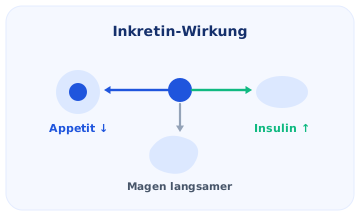
Semaglutide mimics the body's own gut hormone GLP-1 (Glucagon-like Peptide-1). It increases glucose-dependent insulin secretion, suppresses glucagon release, slows gastric emptying, and acts on satiety centers in the hypothalamus, which reduces appetite. The effect is glucose-dependent, which makes the risk of hypoglycemia comparatively low in monotherapy.
The long half-life is due to albumin binding and structural modifications that slow enzymatic breakdown.
Research history
Emerged from GLP-1 research of the 1990s/2000s; developed by Novo Nordisk as a weekly analogue. Approval for type 2 diabetes (Ozempic) in 2017/2018, as an oral form (Rybelsus) in 2019/2020, and for weight management (Wegovy) from 2021. The SELECT trial (2023) additionally showed a reduction in cardiovascular events in overweight people without diabetes.
Positive aspects
What the research shows that is promising
Research areas
- Type 2 diabetes (blood glucose control)
- Obesity / weight management — in the US, also approved as an oral tablet (oral Wegovy) since December 2025
- Cardiovascular risk reduction (SELECT trial; expanded as an indication since 2024)
- Chronic kidney disease in type 2 diabetes (FLOW trial; expanded as an indication in the USA in 2025)
- Non-cirrhotic MASH with advanced liver fibrosis (ESSENCE trial; granted accelerated approval in the USA in 2025)
Documented effects (from the literature)
- Gastrointestinal effects: nausea, vomiting, diarrhea, constipation (especially at the start).
- Appetite reduction and weight loss.
- Slowed gastric emptying.
Risk analysis
What to view critically and honestly
Regulatory status by region
Centrally approved for type 2 diabetes and weight management. Dispensed only on medical prescription.
Ozempic/Rybelsus (diabetes) and Wegovy (obesity). Carries a Boxed Warning regarding thyroid C-cell tumors (from animal studies).
Safety concerns & caution
- Boxed Warning (USA) regarding medullary thyroid carcinoma; contraindicated in cases of personal/family history or MEN-2.
- Reports of pancreatitis and gallbladder problems.
- Possible interactions, e.g. with insulin/sulfonylureas (risk of hypoglycemia).
- Use in pregnancy/breastfeeding is not recommended.
- In 2025 the EMA-PRAC classified the rare eye disorder NAION (sudden, often painless vision loss) as a very rare side effect — inclusion in the product information was recommended.
- Ileus/intestinal obstruction was added to the US product information as a rare, serious gastrointestinal signal.
Risks of gray-market purchase
- Counterfeit and "compounded" semaglutide products are documented — active ingredient content and purity unknown.
- Vials sold as "research grade" are not subject to any pharmaceutical control.
- Incorrect concentration assumptions can lead to substantial dosing errors.
Frequently asked questions
What is the difference between Ozempic, Wegovy and Rybelsus?
It is the same active substance (semaglutide) in different products and approvals: Ozempic (injectable, diabetes), Wegovy (injectable, obesity) and Rybelsus (tablet, diabetes). Since December 2025, Wegovy is additionally approved in the US as a tablet (oral Wegovy) for weight management — Rybelsus remains the tablet for diabetes. Which product is appropriate is a medical decision based on the indication.
Why is it prescription-only?
Because the benefits and risks (e.g. gastrointestinal effects, contraindications, interactions) require a medical assessment of the indication, patient education and follow-up monitoring.
Is "research" semaglutide sold online the same thing?
No. Without pharmaceutical regulatory control, identity, purity and concentration are not assured. Such products are not an approved medicine.
Is it true that semaglutide is now also approved for kidney and liver diseases?
The approval status has expanded since 2024: in the USA, semaglutide was expanded in 2025 for type 2 diabetes with chronic kidney disease (FLOW trial) and received accelerated approval for non-cirrhotic MASH with liver fibrosis (ESSENCE trial); since 2024 there has also been a cardiovascular indication. None of this changes the prescription requirement — assessment of the indication and follow-up belong under medical supervision.
Is there an eye risk with semaglutide?
In 2025 the EMA safety committee classified the rare eye disorder NAION as a very rare side effect (up to 1 in 10,000 users). It presents as sudden, often painless vision loss and can be permanent. If something like this occurs during treatment, it is an emergency sign requiring immediate medical evaluation.
Sources
Primary and reference sources for your own reading.
- PubMedSELECT — Semaglutide and Cardiovascular Outcomes in Obesity without Diabetes (NEJM 2023)
- ClinicalTrials.govFLOW — Effekt von Semaglutid auf chronische Nierenerkrankung (Studienregister)
- EMAPRAC: NAION als sehr seltene Nebenwirkung von Semaglutid (Ozempic, Rybelsus, Wegovy)
- Novo Nordisk / FDANovo Nordisk: FDA-Zulassung der oralen Wegovy-Tablette (orales Semaglutid) zur Gewichtsregulation und kardiovaskulären Risikoreduktion (Dez. 2025)
Related substances
Mentioned in these guide articles
Mentioned in these research updates
Unfamiliar terms? Look them up in the glossary or read the fundamentals.
This profile is for information and education only. It is not medical advice and deliberately contains no dosing or usage details. Decisions about use belong in a doctor’s hands.