Beginner view — everything explained simply.
Machine-assisted translation — the German original version is authoritative.

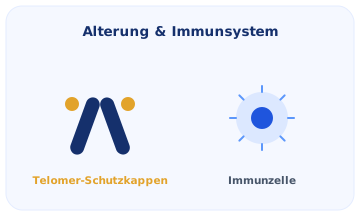
Longevity & Immune system
Humanin
HN · Humanin (HN) · HNG (S14G-Humanin, Analogon) · MT-RNR2-Peptid · mitochondrien-stämmiges Peptid (MDP)
Humanin is a short peptide of 24 amino acids that is read from a segment of mitochondrial DNA (the 16S rRNA region of the MT-RNR2 gene) and is therefore counted among the mitochondria-derived peptides (MDPs). It was discovered in 2001 during the search for factors that protect nerve cells from Alzheimer's-associated cell death, and since then it has been studied mainly in cell-biological and animal research on neuroprotection, metabolism and aging. Observational studies show that humanin levels in the blood decline with age and are higher in certain constellations (e.g., the offspring of centenarians) — but such correlations do not prove cause and effect in humans. Meaningful clinical trials demonstrating a therapeutic benefit of administering humanin in humans are so far lacking. Humanin is not approved as a medicinal product anywhere and remains an experimental research compound.
Regulatory status
Not approved for humans
Humanin is not approved as a medicinal product anywhere — an experimental research compound without proven clinical benefit in humans.
Drug class
Mitochondria-derived peptide (MDP); cytoprotective/neuroprotective research peptide (24 amino acids)
Half-life (informative)
Not reliably characterized in humans; native peptides of this kind are generally considered short-lived in the blood. Synthetic analogues such as HNG (S14G-humanin) were developed in research partly because of their higher stability/potency.
Studied in the literature
In preclinical studies, predominantly administered systemically (parenteral injection in cell and animal models); endogenous levels are measured from blood samples in human studies. These details are purely descriptive and are not instructions for use.
Mechanism of action
In cell and animal models, humanin is described as a cytoprotective, anti-apoptotic signaling peptide. The discussed modes of action include inhibition of the pro-apoptotic protein BAX, binding to the insulin-like growth factor binding protein IGFBP-3, and activation of survival signaling pathways (including STAT3, ERK1/2 and AKT signaling). Through these routes, humanin is thought to protect cells from various stress and toxicity stimuli, such as amyloid-beta-induced neuronal cell death. These mechanisms are characterized predominantly in vitro and in animal models; how relevant they are for the intact human organism has not been conclusively clarified.
A large part of the data comes from cell culture and animal models as well as from the potent analogue HNG; statements on pharmacokinetics and dose-response in humans are not established.
Research history
Humanin was described in 2001 by the research group of Hashimoto and Nishimoto (Keio University, Japan) during the search for factors that protect nerve cells from Alzheimer's-associated insults — hence the name. A follow-up paper published in 2002 in Neuroscience Letters provided evidence of endogenous production of the peptide and its possible role in Alzheimer's disease (PMID 12009529). In the following years, humanin was classified as the first member of the mitochondria-derived peptides, and the research field expanded to metabolism, the cardiovascular system, eye diseases and aging. Later work linked humanin to lifespan and healthspan in animal models as well as to age-dependent blood levels in humans.
Positive aspects
What the research shows that is promising
Research areas
- Neuroprotection and neurodegenerative diseases (including Alzheimer's models, amyloid-beta toxicity)
- Aging, lifespan and healthspan (mitochondria-derived peptides)
- Metabolism and insulin action (metabolic research models)
- Cardiovascular and eye research (protection against cellular stress in models)
- Humanin as a possible age-dependent biomarker in the blood
Documented effects (from the literature)
- Documented in cell and animal models: anti-apoptotic and cytoprotective effects (including BAX inhibition, STAT3 activation).
- Neuroprotective and metabolic effects described in preclinical models (predominantly with the analogue HNG).
- In humans: an observed association of lower blood levels with higher age and with diseases such as Alzheimer's and MELAS — as a correlation, not as a proven effect of administration.
Risk analysis
What to view critically and honestly
Regulatory status by region
No authorization by the EMA as a medicinal product; exclusively a research/laboratory context. No recognized field of application.
No FDA approval; no approved humanin medicinal product. Distribution as a "research chemical" takes place outside pharmaceutical control.
Predominantly preclinical evidence (cell/animal); robust controlled efficacy trials in humans are lacking.
Safety concerns & caution
- Very thin human evidence: robust controlled clinical trials on administering humanin in humans are lacking; a therapeutic benefit is not proven.
- Much is based on cell culture, animal models and the synthetic analogue HNG — transferability to humans is open.
- Long-term safety, side-effect profile, pharmacokinetics and interactions in humans are not characterized.
- As a growth-/survival-promoting signaling peptide, theoretical risks (e.g., effects on cell survival/proliferation) have not been sufficiently studied.
Risks of gray-market purchase
- Gray-market preparations are not pharmaceutically approved or tested; identity, purity and content are uncontrolled.
- Possible contaminants, mislabeling, degradation products or lack of sterility with "research chemicals".
- No medical supervision, no quality standard and no liability — the health and legal risks lie entirely with the user.
- Marketing promises regarding anti-aging, neuroprotection or metabolism are not supported by the available evidence.
Frequently asked questions
Is humanin an approved medicine or anti-aging agent?
No. Humanin is not approved as a medicinal product in either the EU or the USA. It is an experimental research compound; a benefit as an anti-aging or therapeutic agent in humans is not proven.
What does it mean that humanin levels decline with age?
Observational studies show that the humanin levels measurable in the blood decrease with age and are higher in some particularly long-lived people. This is a correlation and describes an association — it does not prove that supplying it from outside influences aging or keeps a person healthy.
How strong is the evidence in humans?
Weak. The majority of the data comes from cell culture, animal models and the synthetic analogue HNG. Controlled clinical trials showing the efficacy and safety of administering humanin in humans are so far lacking.
Sources
Primary and reference sources for your own reading.
- Biology (Basel) — Karachaliou & Livaniou, 2023 (PMID 38132360)Neuroprotective Action of Humanin and Humanin Analogues: Research Findings and Perspectives
- Aging (Albany NY) — Yen et al., 2020 (PMID 32575074)The mitochondrial derived peptide humanin is a regulator of lifespan and healthspan
- Scientific Reports — Yen et al., 2018 (PMID 30242290)Humanin Prevents Age-Related Cognitive Decline in Mice and is Associated with Improved Cognitive Age in Humans
- Neuroscience Letters — Tajima et al., 2002 (PMID 12009529)Evidence for in vivo production of Humanin peptide, a neuroprotective factor against Alzheimer's disease-related insults
Related substances
Mentioned in these guide articles
Unfamiliar terms? Look them up in the glossary or read the fundamentals.
This profile is for information and education only. It is not medical advice and deliberately contains no dosing or usage details. Decisions about use belong in a doctor’s hands.