Beginner view — everything explained simply.
Machine-assisted translation — the German original version is authoritative.

Longevity & Immune System
Epitalon (Epithalon)
Epithalon · AEDG · Ala-Glu-Asp-Gly
Epitalon is a synthetic tetrapeptide based on a peptide found in the pineal gland (epithalamin). It is being researched in the context of aging and telomere biology. It is not approved as a medicine for human use; robust, independently replicated human data are limited.
Regulatory status
Not approved for humans
Not approved — longevity claims not supported by robust human evidence.
Drug class
Synthetic tetrapeptide (epithalamin derivative)
Half-life (informative)
Short; robust human pharmacokinetic data limited.
Studied in the literature
In studies investigated subcutaneously, among others. No approved human use.
Mechanism of action
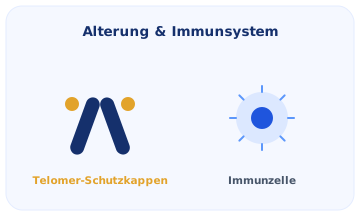
In research, Epitalon is associated with an activation of the enzyme telomerase, which is meant to preserve the telomeres (the protective caps of the chromosomes), which shorten with each cell division. Effects on circadian rhythm and melatonin are also described. These findings come predominantly from animal and cell studies and require independent replication.
The popular telomerase/longevity claims rest largely on preclinical and small studies.
Research history
Traces back to the work of Khavinson and colleagues (St. Petersburg, bioregulation/gerontology). Animal studies (including Anisimov) reported effects on tumor incidence and lifespan in mice. Transferability to humans is not assured.
Positive aspects
What the research shows that is promising
Research areas
- Telomere/aging research (predominantly preclinical)
- Circadian rhythm / melatonin
- Oncological animal models (tumor incidence)
Documented effects (from the literature)
- In animal studies, effects on lifespan and tumor incidence are reported, among others.
- Documented, robust human effects are limited.
Risk analysis
What to view critically and honestly
Regulatory status by region
Not an approved medicine; no established human use.
Safety concerns & caution
- Telomerase activation raises theoretical questions (e.g. in the context of tumor biology) that are not conclusively resolved.
- Long-term safety in humans is not established.
Risks of gray-market purchase
- Sold as an "anti-aging research peptide"; purity and sterility unassured.
- Advertising promises of "life extension" are not scientifically supported.
Frequently asked questions
Does Epitalon demonstrably extend life?
For humans there is no robust evidence for this. The lifespan findings come from animal models and are not transferable to humans.
Is telomerase activation only positive?
Not necessarily. Telomerase also plays a role in tumor biology, which is why uncontrolled activation carries theoretical risks that are unresolved.
Why should the body of study data on Epitalon be read with caution?
A large part of the positive findings comes from a single research group and from animal or cell models; independent, large and well-controlled human studies are largely lacking. Such constellations are prone to publication and confirmation bias — promising individual findings are therefore not proof of efficacy in humans.
Sources
Primary and reference sources for your own reading.
Related substances
Mentioned in these guide articles
Mentioned in these research updates
Unfamiliar terms? Look them up in the glossary or read the fundamentals.
This profile is for information and education only. It is not medical advice and deliberately contains no dosing or usage details. Decisions about use belong in a doctor’s hands.