
Beginner view — everything explained simply.
Machine-assisted translation — the German original version is authoritative.

Melanocortin system
Setmelanotid
Imcivree · RM-493 · BIM-22493 · Setmelanotide
Setmelanotide (brand name Imcivree, development code RM-493) is a synthetic peptide and agonist at the melanocortin-4 receptor (MC4R). It is a prescription-only, regulatory-approved medicine — but only for narrowly defined rare forms of obesity: genetically confirmed forms (POMC, PCSK1 and LEPR deficiency and Bardet-Biedl syndrome) and, in the US since March 2026, acquired (non-genetic) hypothalamic obesity. It was developed by Rhythm Pharmaceuticals; the US approval (FDA) came in 2020, and an EU approval (EMA) also exists. Setmelanotide is expressly not a general weight-loss agent: outside the approved indications, neither efficacy nor safety is established.
Regulatory status
Approved · prescription-only
Prescription-only and regulatory-approved – but exclusively for rare, genetically confirmed forms of obesity, not for general weight reduction.
Drug class
Peptide drug; selective MC4R agonist (melanocortin-4 receptor agonist)
Half-life (informative)
The scientific literature describes an elimination half-life of about 11 hours (StatPearls). No dosing or administration details are deliberately provided here.
Studied in the literature
In the approval studies, setmelanotide was investigated subcutaneously. This describes solely how the substance was scientifically tested and does not constitute an instruction for use. Use occurs exclusively under medical prescription and supervision within the approved indications.
Mechanism of action
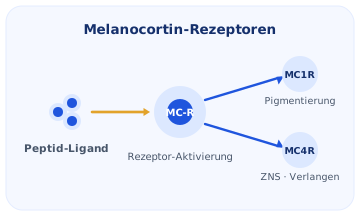
Setmelanotide activates the melanocortin-4 receptor (MC4R) in the hypothalamus. The MC4R signaling pathway lies functionally downstream of the leptin signal and controls appetite, satiety and energy balance. In certain genetic defects (e.g. POMC, PCSK1 or LEPR deficiency as well as in Bardet-Biedl syndrome) this pathway is disrupted, leading to pronounced hunger (hyperphagia) and severe early-onset obesity. Setmelanotide is intended to pharmacologically restore MC4R signaling and thereby curb the pathologically increased appetite. Important: this mechanism is clinically established only in the genetically defined disorders mentioned – it is not a general "appetite brake."
The pharmacological key data come from regulatory documents (FDA prescribing information) and scientific secondary literature (StatPearls). Setmelanotide is a prescription-only medicine; specific use, suitability and monitoring are the responsibility of the treating physician.
Research history
Setmelanotide was developed by Rhythm Pharmaceuticals as a targeted therapy for rare forms of obesity caused by defects in the MC4R signaling pathway. In single-arm, open-label phase 3 trials on POMC and LEPR deficiency (Clément et al., Lancet Diabetes & Endocrinology 2020), 80% of those affected by POMC and 45% of those affected by LEPR achieved a weight reduction of at least 10% after about one year. The FDA granted initial approval in 2020 (Imcivree) for chronic weight management in genetically confirmed POMC, PCSK1 or LEPR deficiency; an EU approval via the EMA followed. On the basis of a placebo-controlled phase 3 trial (Haqq et al., Lancet Diabetes & Endocrinology 2022), the indication was extended in the US and the EU to Bardet-Biedl syndrome; later extensions concerned younger age groups.
Positive aspects
What the research shows that is promising
Research areas
- POMC deficiency (pro-opiomelanocortin deficiency) with severe early-onset obesity and hyperphagia
- PCSK1 deficiency (proprotein convertase subtilisin/kexin type 1)
- LEPR deficiency (leptin receptor defect)
- Bardet-Biedl syndrome (syndromic obesity)
- Investigated but not convincingly established use in Alström syndrome (inconclusive for Alström in the BBS trial)
- Acquired (non-genetic) hypothalamic obesity — an approved indication in the US since March 2026 (phase-3 trial TRANSCEND, from age 4); other disorders of the MC4R pathway remain the subject of clinical research
Documented effects (from the literature)
- Skin changes: hyperpigmentation/skin darkening, darkening of pre-existing pigmented moles (nevi) and new formation of melanocytic nevi – mechanism-related and, according to the prescribing information, reversible after discontinuation; skin checks are required in the label
- Injection-site reactions (e.g. redness/erythema, hypersensitivity reactions at the injection site)
- Nausea and other gastrointestinal complaints
- Events mainly reported in the approval studies were skin hyperpigmentation (very common) and injection-site reactions
Risk analysis
What to view critically and honestly
Regulatory status by region
Approved via the EMA as Imcivree for narrowly defined, genetically caused forms of obesity (including POMC, PCSK1, LEPR deficiency and Bardet-Biedl syndrome). Use only under specialist medical prescription and supervision.
Initial U.S. Approval 2020 as Imcivree for chronic weight management in genetically confirmed POMC, PCSK1 or LEPR deficiency; later expanded to Bardet-Biedl syndrome and younger age groups. In March 2026 the FDA additionally expanded the approval to acquired (non-genetic) hypothalamic obesity from age 4 (phase-3 trial TRANSCEND) — the first approved therapy for this acquired form. For the genetic indications, genetic confirmation remains a prerequisite.
Outside the approved, genetically defined rare diseases, there is no approval. Setmelanotide is not a generally approved weight-loss drug; availability and status vary by country.
Safety concerns & caution
- Disturbances of sexual arousal: spontaneous penile erections in men (including risk of priapism – an erection lasting more than 4 hours is considered a medical emergency) and sexual adverse effects in women (warning in the prescribing information)
- Depression and suicidal ideation: risk of new-onset or worsening depression or suicidality; according to the label, corresponding monitoring is required
- Serious hypersensitivity reactions including anaphylaxis have been reported
- Very narrow approved indication: efficacy and safety are established only for the genetically defined rare forms of obesity – not for general weight reduction
- Special warnings for specific patient groups (including benzyl alcohol content, caution in newborns/"gasping syndrome"; notes on acquired hypothalamic obesity)
Risks of gray-market purchase
- Setmelanotide is prescription-only and intended only for genetically confirmed rare diseases under medical supervision; obtaining it outside this framework (e.g. as a supposed weight-loss drug) is neither approved nor safe.
- "Research chemical" or gray-market products are not subject to pharmaceutical quality control: purity, identity, dosing and sterility are uncertain; impurities and mislabeling are possible.
- Without genetic diagnostics and medical supervision, serious risks (priapism, depression/suicidality, severe skin reactions, anaphylaxis) can neither be recognized nor safely monitored.
- Use outside the approved indication lacks any basis in efficacy and safety and can have considerable consequences both medically and legally.
Frequently asked questions
Is setmelanotide a general weight-loss drug?
No. Setmelanotide is indeed approved, but exclusively for very rare, genetically confirmed forms of obesity (POMC, PCSK1, LEPR deficiency as well as Bardet-Biedl syndrome). For general weight reduction it is neither approved nor established in its efficacy or safety.
How does setmelanotide work in principle?
It activates the melanocortin-4 receptor (MC4R) in the hypothalamus. This pathway controls appetite and energy balance and lies functionally downstream of the leptin signal. In certain genetic defects this pathway is disrupted; setmelanotide is intended to pharmacologically restore the signaling. This benefit is established only in the genetic disorders mentioned.
Is setmelanotide approved?
Yes, it is prescription-only and regulatory-approved – in the US (FDA, initial approval 2020) and in the EU (EMA) as Imcivree. However, the approval applies explicitly only to the narrowly defined, genetically confirmed rare indications, and not beyond them.
Which risks and side effects are documented?
According to the prescribing information, among others skin hyperpigmentation as well as darkening/new formation of pigmented moles, injection-site reactions and nausea. Special warnings apply to disturbances of sexual arousal (including risk of priapism), depression and suicidal ideation as well as serious hypersensitivity reactions up to anaphylaxis. Medical supervision is required.
Does PeptidLotse provide guidance on dosing or administration?
No. PeptidLotse is a purely educational information resource and, as a matter of principle, provides no details on dosing, preparation or administration. Setmelanotide is a prescription-only medicine; suitability, prescription and monitoring belong exclusively in medical hands.
Sources
Primary and reference sources for your own reading.
- U.S. Food and Drug Administration (FDA) / DailyMedIMCIVREE (setmelanotide) injection – Highlights of Prescribing Information (Initial U.S. Approval 2020)
- Clément K, et al. – Lancet Diabetes & Endocrinology 2020 (PMID 33137293)Efficacy and safety of setmelanotide, an MC4R agonist, in individuals with severe obesity due to LEPR or POMC deficiency: single-arm, open-label, multicentre, phase 3 trials
- Haqq AM, et al. – Lancet Diabetes & Endocrinology 2022 (PMID 36356613)Efficacy and safety of setmelanotide, a melanocortin-4 receptor agonist, in patients with Bardet-Biedl syndrome and Alström syndrome: a multicentre, randomised, double-blind, placebo-controlled, phase 3 trial
- StatPearls Publishing / NCBI Bookshelf (NBK589641)Setmelanotide – StatPearls
- Healio / FDAFDA erweitert Setmelanotid (Imcivree) auf die erworbene hypothalamische Adipositas (Phase-3-Studie TRANSCEND, ab 4 Jahren)
Related substances
Unfamiliar terms? Look them up in the glossary or read the fundamentals.
This profile is for information and education only. It is not medical advice and deliberately contains no dosing or usage details. Decisions about use belong in a doctor’s hands.