Beginner view — everything explained simply.
Machine-assisted translation — the German original version is authoritative.

Growth hormone system
IGF-1 LR3
Long R3 IGF-1 · LongR3 IGF-I · Long R3 IGF-I · IGF-I LR3 · LR3-IGF-1 · Long Arg3 IGF-I
IGF-1 LR3 (Long R3 IGF-1) is a synthetic analogue of insulin-like growth factor 1 (IGF-1). Compared with the body's own IGF-1 (70 amino acids), it carries two modifications: a substitution at position 3 (glutamic acid → arginine, “R3”) and an additional 13-amino-acid extension at the N-terminus (83 amino acids in total). These modifications drastically reduce binding to the IGF-binding proteins (IGFBPs) and thereby prolong the duration of action, while binding to the IGF-1 receptor is largely preserved. IGF-1 LR3 was developed as a cell-culture/research reagent (among other things to promote cell growth in biotechnological protein production) and is diverted into the bodybuilding grey market. It is explicitly not a medicine approved for humans. An important distinction: the approved IGF-1 medicine is mecasermin (trade name Increlex) – a recombinant human IGF-1 (rhIGF-1) for narrowly defined rare growth disorders in children. Mecasermin is a DIFFERENT substance from IGF-1 LR3: Increlex corresponds to natural IGF-1, whereas LR3 is a long-acting, artificially modified analogue and holds no marketing authorisation as a medicine.
Regulatory status
Not approved for humans
Not approved as a medicine – sold as a research reagent and on the bodybuilding grey market; consistently banned in sport (WADA, Class S2). Not to be confused with the approved IGF-1 medicine mecasermin/Increlex.
Drug class
Synthetic, long-acting IGF-1 analogue (research/cell-culture reagent); not an approved drug substance
Half-life (informative)
In the reagent and secondary literature, IGF-1 LR3 is credited with a markedly longer duration of action than native IGF-1; native IGF-1 is rapidly buffered in the blood by IGFBP binding (free half-life in the range of minutes), whereas LR3, owing to its strongly reduced IGFBP binding, remains freely available for longer. No dosing or application details are deliberately provided here. These figures derive from the reagent literature and not from approved clinical studies in humans.
Studied in the literature
IGF-1 LR3 has not been clinically studied as a human therapeutic agent, but has been used predominantly in cell culture and in preclinical animal/in vitro models. Where parenteral administration is described in such models, this describes solely the experimental procedure in research and does not constitute an application instruction. For humans there is no approved use and no application instruction.
Mechanism of action
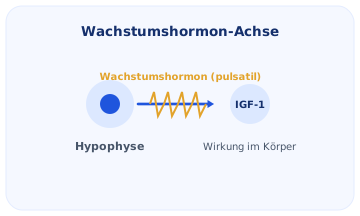
IGF-1 LR3 acts as an agonist at the IGF-1 receptor (IGF-1R), a receptor tyrosine kinase. Receptor activation sets anabolic and proliferative signalling pathways in motion – in particular the PI3K/AKT/mTOR and Ras/Raf/MAPK axes – which promote cell growth, cell division and protein synthesis and inhibit programmed cell death. The decisive difference from the body's own IGF-1: through the arginine substitution at position 3 and the N-terminal extension, LR3 binds the IGF-binding proteins (IGFBPs) far more weakly. Native IGF-1 molecules are largely bound in the blood by IGFBPs (especially IGFBP-3) and thereby “buffered”; LR3 largely escapes this buffering, remains freely available for longer and activates the receptor for longer. Because the IGF-1 receptor is structurally related to the insulin receptor, IGF-1R activation can also trigger insulin-like, blood-sugar-lowering effects.
The key pharmacological data derive from reagent/secondary literature and manufacturer information on research reagents, not from regulatory authorisation dossiers for a human medicine. For distinction: for the approved medicine mecasermin (Increlex), which corresponds to natural IGF-1, officially reviewed pharmacological data are available – these expressly do not apply to the analogue IGF-1 LR3.
Research history
IGF-1 LR3 originated as a biotechnological research reagent. Under brand names such as LONG®R3 IGF-I it is used above all in cell culture – for example as a potent growth-factor supplement to increase cell survival and product yield in recombinant protein manufacture (e.g. in CHO cell lines) and in basic research on muscle, bone, nerve and metabolic cells as a surrogate for sustained IGF-1R activation. From this laboratory context the substance was later diverted into the bodybuilding/performance-sport grey market and promoted as a supposedly muscle-building agent – without any pharmaceutical-regulatory review or authorisation for use in humans ever having taken place.
Positive aspects
What the research shows that is promising
Research areas
- Cell culture/biotechnology: use as a potent growth-factor supplement to increase cell growth, cell survival and product yield (e.g. in recombinant protein production) – no relevance to use in humans
- Preclinical basic research on IGF-1R signalling pathways in muscle, bone, nerve and metabolic cells as a surrogate for sustained receptor activation (animal/in vitro models)
- Important safety context: activation of the IGF-1 receptor is prominently associated in preclinical and clinical investigations with cell proliferation and tumour biology (carcinogenesis, progression, treatment resistance) – a central risk topic, not a proven application
- Hypoglycaemia risk: because of the relatedness of the IGF-1 and insulin receptors, blood-sugar-lowering (insulin-like) effects are a recurring safety topic – no proof of therapeutic benefit
- Note: all the areas mentioned are to be classified as preclinical/cell-biological or risk-related; there is no therapeutic benefit of IGF-1 LR3 proven in humans (preclinical ≠ proven in humans)
Documented effects (from the literature)
- Insulin-like, blood-sugar-lowering effect as a known pharmacological effect of IGF-1R/insulin-receptor activation (hypoglycaemia potential)
- Promotion of cell growth and cell division as the intended biological effect at the IGF-1 receptor (documented in the reagent/model context)
- For humans there are no controlled safety data from approved clinical studies; reported effects derive from preclinical/cell-biological contexts or from IGF-1 physiology
Risk analysis
What to view critically and honestly
Regulatory status by region
IGF-1 LR3 holds no marketing authorisation as a medicine in the EU. It is traded as a research/laboratory reagent; promotion or supply for use in humans is not covered by this. The only IGF-1 medicine approved in the EU is mecasermin (Increlex) – a different substance for narrowly defined rare indications.
The FDA has not approved IGF-1 LR3 as a medicine. It is typically marketed as a “research use only” reagent. The only FDA-reviewed product is mecasermin (Increlex), the recombinant human IGF-1 for the long-term treatment of growth failure in children with severe primary IGF-1 deficiency (first approval 2005) – but not the analogue LR3.
IGF-1 and its analogues – including long-chain variants such as IGF-1 LR3 – fall under Class S2 (peptide hormones, growth factors, related substances and mimetics) of the WADA Prohibited List. Exogenous IGF-1 is prohibited at all times, both in-competition and out-of-competition.
Safety concerns & caution
- Hypoglycaemia (low blood sugar): because of the relatedness of the IGF-1 and insulin receptors, a pronounced drop in blood sugar can occur – a potentially acutely dangerous effect.
- Cancer/tumour promotion (a risk signal that is theoretical and broadly documented in research): activation of the IGF-1 receptor promotes cell proliferation and is associated in numerous preclinical and clinical works with carcinogenesis, tumour progression and treatment resistance.
- Acromegaly-like effects: sustained excessive activation of the growth axis can in principle lead to uncontrolled tissue growth (a risk consideration analogous to IGF-1/growth-hormone excess).
- No human safety data: for IGF-1 LR3 there are no authorisation studies in humans; benefit, tolerability and long-term consequences are not established in humans.
- Risk of confusion with the approved medicine mecasermin/Increlex: Increlex is officially reviewed, LR3 is not – the safety data for mecasermin expressly do not apply to LR3.
Risks of gray-market purchase
- Sale as a “research use only”/research reagent: such products are not subject to any pharmaceutical quality control – purity, identity, actual content and sterility are uncertain; contaminants and mislabelling are possible.
- Advertising claims from the bodybuilding milieu are assertions, not proven facts: a benefit proven safe in humans does not exist.
- Lack of medical supervision: serious risks such as hypoglycaemia or possible tumour-promoting effects can neither be recognised nor safely managed without medical monitoring.
- Sport ban: IGF-1 and its analogues (including LR3) are prohibited at all times under WADA (Class S2); a positive finding can lead to sanctions.
- Legal uncertainty: acquisition and use outside the research context fall into a legal grey area and, depending on the country, can have consequences under medicines or criminal law.
Frequently asked questions
Is IGF-1 LR3 the same as the approved medicine Increlex (mecasermin)?
No. Increlex (active substance mecasermin) is recombinant human IGF-1 (rhIGF-1), which corresponds to natural IGF-1 and is approved for narrowly defined rare growth disorders in children (first FDA approval 2005). IGF-1 LR3, by contrast, is an artificially modified, long-acting IGF-1 analogue with an amino-acid substitution (R3) and an N-terminal extension – it is a research reagent and holds no marketing authorisation as a medicine. The two substances are not interchangeable, and the reviewed safety data for mecasermin do not apply to LR3.
Is IGF-1 LR3 approved for humans?
No. IGF-1 LR3 is approved as a human medicine neither in the EU nor in the USA. It is traded as a research/cell-culture reagent and diverted onto the bodybuilding grey market. A therapeutic benefit proven in humans does not exist.
Why is IGF-1 LR3 considered particularly risky?
Above all for two reasons: first, because of the relatedness of the IGF-1 and insulin receptors it can cause dangerous hypoglycaemia (low blood sugar). Second, activation of the IGF-1 receptor promotes cell growth and cell division and has been broadly linked in research to carcinogenesis and tumour progression. In addition, there are no controlled safety data for humans.
Is IGF-1 LR3 permitted in sport?
No. IGF-1 and its analogues – including long-chain variants such as IGF-1 LR3 – are on the WADA Prohibited List under Class S2 (peptide hormones, growth factors and related substances). Exogenous IGF-1 is prohibited at all times, in-competition as well as out-of-competition.
Does PeptidLotse give guidance on dosing, preparation or use?
No. PeptidLotse is a purely educational information resource and as a matter of principle provides no information on dosing, preparation or use. IGF-1 LR3 is not an approved medicine; safe use in humans is not established.
Sources
Primary and reference sources for your own reading.
- Wikipedia (englischsprachiger Übersichtsartikel mit Quellenangaben)IGF-1 LR3 (Long R3 IGF-1) – Struktur (Arg3-Austausch, 13-Aminosäuren-N-terminale Verlängerung), reduzierte IGFBP-Bindung und verlängerte Wirkdauer
- Wikipedia (englischsprachiger Übersichtsartikel mit Quellenangaben)Mecasermin (Increlex) – rekombinantes humanes IGF-1, zugelassene Indikation und Abgrenzung zum nativen IGF-1
- U.S. Food and Drug Administration (FDA)INCRELEX (mecasermin) injection – Highlights of Prescribing Information
- U.S. Anti-Doping Agency (USADA)IGF-1 and the World Anti-Doping Agency Prohibited List (exogenes IGF-1 und Analoga jederzeit verboten, Klasse S2)
- Frontiers in Endocrinology 2022 / PubMed Central (PMC9395641)Insulin-like growth factor-1 signaling in the tumor microenvironment: Carcinogenesis, cancer drug resistance, and therapeutic potential
Related substances
Unfamiliar terms? Look them up in the glossary or read the fundamentals.
This profile is for information and education only. It is not medical advice and deliberately contains no dosing or usage details. Decisions about use belong in a doctor’s hands.