Beginner view — everything explained simply.
Machine-assisted translation — the German original version is authoritative.
Growth Hormone System
GHRP-2
Pralmorelin · KP-102 · Growth Hormone Releasing Peptide-2
GHRP-2 (pralmorelin) is a synthetic hexapeptide from the family of "growth hormone releasing peptides". It binds the ghrelin receptor (GHS-R1a) and triggers a pulsatile release of growth hormone. In Japan, pralmorelin is approved as a GH stimulation test (diagnostics); as a general-use peptide it is not approved and is mostly traded as a "research chemical". In sport it is banned at all times.
Regulatory status
Not approved for humans
Not approved as a therapeutic medicine; in Japan as a diagnostic agent (pralmorelin); in sport (WADA) banned at all times.
Drug class
Synthetic GH secretagogue (ghrelin receptor agonist)
Half-life (informative)
Short (in the range of minutes).
Studied in the literature
In studies subcutaneously or intravenously (including as a GH stimulation test), controlled.
Mechanism of action
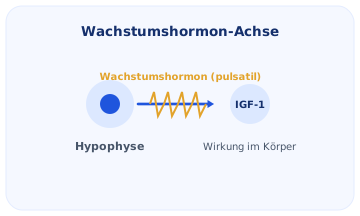
GHRP-2 activates the growth hormone secretagogue receptor GHS-R1a (ghrelin receptor) in the pituitary and hypothalamus and triggers GH release; it acts synergistically with GHRH. Per microgram it is a stronger GH secretagogue than GHRP-6 and triggers somewhat less hunger, but can slightly raise cortisol and prolactin.
Acts via the body's own GH axis — it is not a growth hormone replacement.
Research history
GHRP-2 emerged from Cyril Bowers' work on Met-enkephalin derivatives (1980s). GHRP-6 was the first of these peptides, GHRP-2 a more potent follow-up peptide of the same line.
Positive aspects
What the research shows that is promising
Research areas
- GH stimulation test / diagnostics
- Research on growth hormone deficiency
- Ghrelin signaling pathway and appetite regulation
Documented effects (from the literature)
- Transient rise in GH and IGF-1.
- Increased appetite, fluid retention.
- Slight elevation of cortisol and prolactin possible.
Risk analysis
What to view critically and honestly
Regulatory status by region
Approved for the GH stimulation test, not as a general-use peptide.
No approval for human use; distribution as a "research chemical".
Growth hormone secretagogues are on the WADA Prohibited List at all times.
Safety concerns & caution
- Chronic GH stimulation outside a medical indication has not been studied.
- Insulin resistance possible; problematic in tumor disease (GH/IGF-1 axis).
Risks of gray-market purchase
- The "research only" label circumvents medicines law — identity and purity are unknown.
- Mixed and combination preparations are common.
Frequently asked questions
Is GHRP-2 a growth hormone?
No. It is a secretagogue: it stimulates the pituitary to release its own GH instead of supplying growth hormone.
Why is GHRP-2 banned in sport?
Because it raises GH and IGF-1 and is therefore relevant to performance and recovery. Growth hormone secretagogues are on the WADA Prohibited List at all times.
Sources
Primary and reference sources for your own reading.
Related substances
Unfamiliar terms? Look them up in the glossary or read the fundamentals.
This profile is for information and education only. It is not medical advice and deliberately contains no dosing or usage details. Decisions about use belong in a doctor’s hands.