Beginner view — everything explained simply.
Machine-assisted translation — the German original version is authoritative.

Endocrine & reproduction
Gonadorelin
GnRH · LHRH · Gonadotropin-Releasing-Hormon · Luteinisierendes-Hormon-Releasing-Hormon · Gonadorelinacetat · Gonadorelinhydrochlorid · Factrel · Lutrepulse
Gonadorelin is the synthetic, structurally identical form of gonadotropin-releasing hormone (GnRH, also called LHRH), a hypothalamic releasing hormone composed of ten amino acids. It prompts the pituitary to release the gonadotropins LH (luteinizing hormone) and FSH (follicle-stimulating hormone). Clinically, gonadorelin is used primarily for diagnostic purposes (functional testing of the pituitary–gonadotrope axis) and – when given in pulsatile fashion – in certain forms of infertility and hypogonadotropic hypogonadism. More recently, gonadorelin has become popular in the TRT or “restart” scene (testosterone replacement therapy) as an off-label agent intended to preserve testicular function – this benefit is expressly classified here as off-label and as a claim rather than an established fact. A central pharmacological principle is that pulsatile administration stimulates the axis, whereas continuous, sustained exposure downregulates it. This page is purely educational and contains no instructions for use.
Regulatory status
Approved · prescription-only
Prescription medicine (used in endocrinological diagnostics and – pulsatile – for certain fertility indications). Use as a “restart” or adjunct agent for testosterone replacement therapy (TRT) is off-label and not covered by the corresponding approvals.
Drug class
Releasing hormone (GnRH/LHRH analog; decapeptide, structurally identical to endogenous GnRH)
Half-life (informative)
Very short: the distribution half-life is in the range of a few minutes, the terminal half-life roughly in the range of minutes to a few dozen minutes; breakdown occurs through enzymatic hydrolysis into smaller peptide fragments. This short duration of action is the reason a pulsatile administration pattern is needed for stimulatory therapy. (No dosing or usage details.)
Studied in the literature
In studies and in clinical diagnostics/therapy, gonadorelin has been administered parenterally – diagnostically as a single dose for functional testing, therapeutically in pulsatile form by means of a micro-infusion pump. These details describe solely HOW gonadorelin has been studied and do not constitute instructions for use.
Mechanism of action
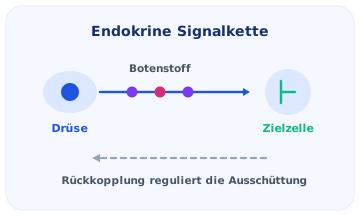
Gonadorelin binds to GnRH receptors on the gonadotrope cells of the anterior pituitary and triggers the release of LH and FSH. The decisive factor is the temporal pattern of exposure: pulsatile (burst-like) stimulation mimics natural hypothalamic secretion and sustains gonadotropin output, whereas continuous, sustained exposure produces the opposite effect – a downregulation of the axis with reduced LH/FSH secretion. Pulsatile gonadorelin therefore acts as a stimulant (for example to induce spermatogenesis or ovulation), while continuously administered GnRH analogs act as suppressants. Animal and in vitro studies show that the response differs in a gene- and subunit-specific manner; the precise molecular basis of the sustained-exposure effects (classically described as “desensitization”) is the subject of ongoing research.
The distinction between pulsatile (stimulatory) and continuous (downregulating) exposure is central to understanding gonadorelin. Availability, regulatory status, and marketed dosage forms differ considerably from country to country and have changed historically.
Research history
Gonadotropin-releasing hormone was isolated in the early 1970s by the research groups of Andrew V. Schally and Roger Guillemin and characterized structurally as a decapeptide – an achievement honored in 1977 with the Nobel Prize in Physiology or Medicine. The synthetic equivalent gonadorelin was subsequently developed both as a diagnostic agent (e.g., Factrel) and for pulsatile fertility treatment (e.g., Lutrepulse) and approved in several countries. The availability of the individual finished products has changed over time.
Positive aspects
What the research shows that is promising
Research areas
- Diagnostic functional testing of the hypothalamic–pituitary–gonadal axis (GnRH test to assess LH/FSH reserve)
- Pulsatile therapy in congenital/hypogonadotropic hypogonadism (including Kallmann syndrome) to induce spermatogenesis or pubertal development – investigated in clinical studies
- Pulsatile ovulation induction in hypothalamic amenorrhea / certain forms of female infertility
- Off-label use to preserve testicular function or fertility during testosterone replacement therapy (TRT) – to be classified as off-label and largely claimed, not proven
- Basic research into the regulation of gonadotropin subunits and GnRH receptors under pulsatile vs. continuous exposure (animal/in vitro)
Documented effects (from the literature)
- In diagnostic and therapeutic use, gonadorelin is regarded in the literature as predominantly well tolerated; pulsatile therapy studies reported only few, mostly mild adverse events.
- Reactions at the injection/application site (e.g., redness, swelling) have been described, as well as occasional headache, nausea, or sensations of warmth.
- Hypersensitivity reactions are documented as a risk, in rare cases extending to more severe allergic reactions.
- Because gonadorelin intervenes in hormone regulation, changes in sex hormone levels may occur depending on the application.
Risk analysis
What to view critically and honestly
Regulatory status by region
Approved or marketed gonadorelin preparations (diagnostic agent as well as pulsatile fertility therapy) differ by member state; the actual availability of the finished products is country-dependent.
In the past, the FDA approved gonadorelin preparations – Factrel (diagnostics of pituitary gonadotrope function) and Lutrepulse (pulsatile ovulation induction). Both branded products were withdrawn from the market (commercial reasons, not because of safety or efficacy concerns). Currently there is no FDA-approved human gonadorelin product as a regular finished medicine on the US market; in the TRT/men's-health scene, gonadorelin circulates predominantly as a preparation produced by compounding pharmacies, which is not equivalent to an FDA-approved product.
In many countries gonadorelin is available on prescription as a diagnostic agent and/or fertility therapeutic; alongside this there is broad veterinary use. Regulatory status and marketed dosage forms vary widely.
Safety concerns & caution
- Off-label use in the TRT/“restart” context is not well validated; robust human studies specifically demonstrating preservation of fertility or testicular function under TRT with gonadorelin are limited – claims to this effect should not be understood as established facts.
- The effect depends heavily on the administration pattern: pulsatile, gonadorelin acts as a stimulant; continuous, it can downregulate the axis – improper use can therefore produce the opposite of the hoped-for effect.
- Interventions in the hypothalamic–pituitary–gonadal axis belong in medical hands with appropriate diagnostics and follow-up monitoring; self-directed control of the hormone axis is risky.
- Hypersensitivity to the active substance constitutes a contraindication.
Risks of gray-market purchase
- On the gray/black market, “gonadorelin” is sold by research-peptide vendors declared as “for laboratory use only”; the identity, purity, actual content, and sterility of such material are unknown and not officially verified.
- Because no approved finished medicine is available in some countries, users turn to compounded or gray-market material – this is not equivalent to an approved medicine and is not subject to the same quality standards.
- Self-directed manipulation of the HPG/HPTA axis without medical supervision is risky and can lead to undesirable hormonal shifts.
- Efficacy promises circulating in the scene (e.g., guaranteed preservation of fertility under TRT) are claims and not facts backed by robust evidence.
Frequently asked questions
What exactly is gonadorelin?
Gonadorelin is the synthetic, structurally identical form of the body's own gonadotropin-releasing hormone (GnRH/LHRH), a decapeptide made up of ten amino acids. It is produced in the hypothalamus and controls the release of the pituitary hormones LH and FSH, which in turn regulate the testes or ovaries.
What is gonadorelin used for in medicine?
Classic areas of use are the diagnostic functional testing of the pituitary–gonadotrope axis (GnRH test) and – in pulsatile form via a pump – certain fertility treatments, such as in hypogonadotropic hypogonadism or hypothalamic amenorrhea. These applications are carried out under medical supervision.
Why is a distinction made between pulsatile and continuous administration?
The temporal pattern determines the direction of effect: pulsatile (burst-like) stimulation mimics natural GnRH secretion and stimulates the axis. Continuous, sustained exposure does the opposite and downregulates LH/FSH output. It is precisely this principle that continuously acting GnRH analogs exploit in reverse to suppress the axis.
Is gonadorelin a safe addition to testosterone replacement therapy (TRT)?
That cannot be affirmed across the board. The use of gonadorelin in the TRT or “restart” context is off-label, and robust human studies demonstrating preservation of fertility or testicular function here are limited. Statements to this effect are claims, not established facts. Such use belongs – if at all – in medical hands with diagnostics and follow-up monitoring. This page gives no recommendation for use.
Does gonadorelin require a prescription?
Yes. Where gonadorelin is available as a medicine, it is prescription-only. In the USA, the formerly approved branded products (Factrel, Lutrepulse) were withdrawn from the market; there, gonadorelin circulates in the men's-health scene predominantly as compounded material, which is not equivalent to an approved medicine. This page serves solely for information and not as a guide to acquisition or use.
What should one pay particular attention to regarding the gray market?
Gonadorelin declared as “for research purposes only” from peptide vendors is not officially verified – identity, purity, content, and sterility are unknown. Self-directed manipulation of the hormone axis without medical supervision is risky, and circulating efficacy promises should be regarded as claims.
Sources
Primary and reference sources for your own reading.
- WikipediaGonadorelin
- Annals of Translational Medicine (PMC8267282; PMID 34277762)Efficacy and safety of pulsatile gonadotropin-releasing hormone therapy in patients with congenital hypogonadotropic hypogonadism: a multicentre clinical study
- Archives of Endocrinology and Metabolism (PMC11156179; PMID 38739523)Pulsatile gonadotropin releasing hormone therapy for spermatogenesis in congenital hypogonadotropic hypogonadism patients who had poor response to combined gonadotropin therapy
- Scientific Reports / Nature (PMC6934515; PMID 31882740)Divergent expression patterns of pituitary gonadotropin subunit and GnRH receptor genes to continuous GnRH in vitro and in vivo
Related substances
Unfamiliar terms? Look them up in the glossary or read the fundamentals.
This profile is for information and education only. It is not medical advice and deliberately contains no dosing or usage details. Decisions about use belong in a doctor’s hands.