Beginner view — everything explained simply.
Machine-assisted translation — the German original version is authoritative.

Endocrine & reproduction
Oxytocin
Oxt · OXT · Syntocinon · Pitocin · Oxytocinum
Oxytocin is an endogenous peptide hormone of nine amino acids, produced in the hypothalamus and released via the posterior pituitary (neurohypophysis). As an injectable medicine (e.g. Pitocin, Syntocinon) it is approved in obstetrics — for instance to induce or augment labour under medical indication, as well as to control bleeding after birth (postpartum haemorrhage). This is to be distinguished from its separate marketing as an intranasal "love" or "cuddle hormone" for the alleged promotion of bonding, trust and social behaviour: for these purposes the evidence is inconsistent and mixed, and such products are not approved for them. The obstetric use takes place exclusively under clinical monitoring. This account serves information purposes only and is not a set of usage instructions.
Regulatory status
Approved · prescription-only
As an obstetric medicine it is prescription-only and approved; intranasal "bonding"/"cuddle hormone" applications are not approved for social/psychiatric purposes.
Drug class
Peptide hormone (neurohypophyseal hormone / nonapeptide)
Half-life (informative)
Short plasma half-life (in the range of minutes); rapid breakdown, among others by the enzyme oxytocinase. No dosing or usage information is deliberately given here.
Studied in the literature
In obstetrics, oxytocin is studied and used as a medicine intravenously or intramuscularly under clinical monitoring; in behavioural and social research, intranasal administration is predominantly studied. This statement describes solely HOW it has been studied and does not constitute a set of usage instructions.
Mechanism of action
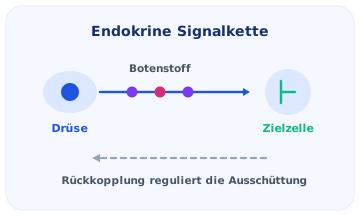
Oxytocin acts as an agonist at the oxytocin receptor (OXTR), a G-protein-coupled receptor. Peripherally it triggers contraction of the smooth muscle of the uterus (labour-promoting) and mediates the milk-ejection reflex (milk let-down) by contracting the myoepithelial cells of the mammary gland. In the central nervous system, oxytocin is attributed a role in social and bonding-related (affiliative) behaviour; these central-nervous functions are predominantly the subject of research and have not been conclusively clarified in humans. Whether and to what extent intranasally administered oxytocin allows functionally relevant amounts to reach the brain via the nose-to-brain route is scientifically disputed.
Central-nervous uptake and efficacy after intranasal administration (nose-to-brain transport) is controversially discussed in the literature. Methodological problems — variable application, uncertain CNS penetration, low statistical power, publication bias — complicate the interpretation of the behavioural studies.
Research history
The chemical structure and synthesis of oxytocin was elucidated in 1953 by Vincent du Vigneaud; it was one of the first peptide hormones to be synthesised, for which du Vigneaud received the Nobel Prize in Chemistry in 1955. Synthetic oxytocin has been used in obstetrics for decades and is among the established medicines. The hypothesis of the "bonding" or "cuddle hormone" arose chiefly from animal-experimental and human behavioural research of recent decades and was later heavily marketed in popular-science form.
Positive aspects
What the research shows that is promising
Research areas
- Obstetrics: induction and augmentation of labour as well as control of bleeding after birth (established, approved use under clinical monitoring).
- Autism spectrum / social cognition: intranasal oxytocin is investigated as a possible modulator of social skills; meta-analyses show at most small effects on social behaviour and no clear effect on routinized/repetitive behaviours (evidence mixed, possible publication bias).
- Anxiety, stress reactivity and social trust: the subject of experimental behavioural research with inconsistent results — no robust basis for broad clinical application.
- Breastfeeding/lactation: physiological role in the milk-ejection reflex (research and physiological context).
Documented effects (from the literature)
- Obstetric effects: triggering or augmentation of uterine contractions; milk let-down.
- Uterine overstimulation: strong (hypertonic) or sustained (tetanic) contractions, which can lead to a precipitous course of labour and, in extreme cases, to uterine rupture.
- Water intoxication/hyponatraemia: through its antidiuretic intrinsic action, fluid retention, seizures and, in severe cases, coma can occur — particularly with prolonged infusion.
- Cardiovascular reactions: among others cardiac arrhythmias (e.g. ventricular extrasystoles), blood-pressure changes.
Risk analysis
What to view critically and honestly
Regulatory status by region
In EU countries it is approved as an injectable obstetric medicine (e.g. Syntocinon). There is no approval as an intranasal agent for the promotion of bonding or social behaviour.
Approved by the FDA as Pitocin (oxytocin injection) for obstetric indications (induction/augmentation of labour, control of postpartum bleeding, management accompanying abortions). Intranasal "love hormone" applications are not approved for that.
Oxytocin is established worldwide as an obstetric medicine and is listed on the WHO List of Essential Medicines. Its marketing as an intranasal "love/cuddle hormone" for behavioural modulation is off-label or unapproved.
Safety concerns & caution
- The obstetric use may take place exclusively under medical supervision and clinical monitoring; relevant risks include water intoxication/hyponatraemia, uterine overstimulation and cardiovascular effects.
- The evidence for intranasal behavioural/"bonding" applications is weak to inconsistent; a reliable benefit in social or psychiatric indications is not established.
- Claims such as "love" or "cuddle hormone" are marketing assertions and not established facts.
Risks of gray-market purchase
- Unregulated "oxytocin nasal sprays" or supplement products: content, purity and actual active-ingredient quantity are unknown and not officially verified.
- Advertising claims regarding bonding, trust or empathy are to be classified as assertion ("…") and not as an established effect.
- Uncontrolled self-administration bypasses the clinical monitoring that is warranted for a hormone with cardiovascular and antidiuretic effects.
Frequently asked questions
Is the "love/cuddle hormone" nasal spray scientifically established?
No — the evidence is mixed and inconsistent. Meta-analyses find at most small effects of intranasal oxytocin on social behaviour (e.g. in the autism context) and no clear effect on repetitive behaviours; moreover, the results may be overestimated due to publication bias. In addition, it is disputed whether intranasally administered oxytocin reaches the brain in functionally relevant amounts at all. "Cuddle hormone" is therefore a marketing assertion, not an established proof of effect.
What is oxytocin officially approved for?
As an injectable medicine, oxytocin is approved in obstetrics, for instance to induce or augment labour under medical indication and to control bleeding after birth. This use takes place exclusively under medical supervision in the clinical setting. There is no approval for intranasal "bonding" or behavioural purposes.
Which risks are documented?
In the approved obstetric use, documented risks include uterine overstimulation (with risk of uterine rupture), water intoxication/hyponatraemia with possible seizures, and cardiovascular effects including cardiac arrhythmias. For this reason, oxytocin may only be used under clinical monitoring. For unregulated nasal-spray products, content and purity are unknown.
Does intranasal oxytocin reach the brain?
That is scientifically disputed. A direct nose-to-brain transport along olfactory and trigeminal nerve pathways, as well as indirect, peripherally mediated routes, are discussed. Some studies point to central-nervous effects, but methodological weaknesses and inconsistent findings do not allow a clear statement.
Sources
Primary and reference sources for your own reading.
- U.S. National Library of Medicine (DailyMed)PITOCIN (oxytocin injection) – FDA Prescribing Information
- Psychoneuroendocrinology (Elsevier) – PubMedThe effects of oxytocin administration on social and routinized behaviors in autism: A preregistered systematic review and meta-analysis
- Molecular Psychiatry (Nature) – PubMedAdvances in the field of intranasal oxytocin research: lessons learned and future directions for clinical research
- Pharmaceutics (MDPI) – PMCEffects of Intranasal Administration of Oxytocin and Vasopressin on Social Cognition and Potential Routes and Mechanisms of Action
Related substances
Unfamiliar terms? Look them up in the glossary or read the fundamentals.
This profile is for information and education only. It is not medical advice and deliberately contains no dosing or usage details. Decisions about use belong in a doctor’s hands.