Beginner view — everything explained simply.
Machine-assisted translation — the German original version is authoritative.

Metabolism & Weight
Mazdutid
Mazdutide · IBI362 · LY3305677
Mazdutide (development codes IBI362 / LY3305677) is a once-weekly peptide that, as a dual agonist, simultaneously activates the GLP-1 receptor and the glucagon receptor. It is an oxyntomodulin analog with an attached fatty-acid side chain. It is being developed by Innovent Biologics (China) under a license from Eli Lilly. In June 2025, Mazdutide received NMPA approval in China for chronic weight management, and in September 2025 for glycemic control in type 2 diabetes; according to the manufacturer it is the world's first approved dual GCG/GLP-1 receptor agonist. Outside China (in particular the EU and the USA) Mazdutide is not approved and remains experimental there. This profile is for informational purposes only and contains no instructions for use.
Regulatory status
Approved · prescription-only
Approved in China (NMPA) for weight management and type 2 diabetes; not approved in the EU and USA and still experimental.
Drug class
Peptide-based dual GLP-1/glucagon receptor agonist (oxyntomodulin analog with a fatty-acid side chain)
Half-life (informative)
Pharmacokinetically, Mazdutide is designed for once-weekly administration; the fatty-acid side chain prolongs its residence time in the body. No information on dosing, amounts, or administration intervals is deliberately provided here.
Studied in the literature
In the clinical trials, Mazdutide was administered and studied subcutaneously (under the skin). This describes only HOW it was used in research and does not constitute instructions for use.
Mechanism of action
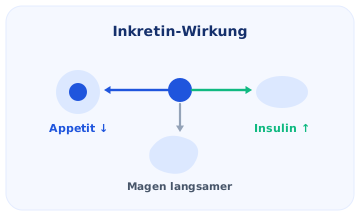
Mazdutide acts as a dual agonist at two receptors at once. Via the GLP-1 receptor, appetite-suppressing effects, slowed gastric emptying, and improved insulin secretion are described—as with other incretin mimetics. Via the glucagon receptor, energy expenditure is additionally said to be increased, fatty-acid oxidation promoted, and liver fat content reduced. This combination is discussed in the scientific literature as a possible mechanism for the weight reduction observed in studies and for favorable cardiometabolic changes. Structurally, Mazdutide is an analog of the body's own gut hormone oxyntomodulin, which naturally targets both receptors.
Statements on efficacy and tolerability come predominantly from studies in Chinese adults with overweight/obesity or type 2 diabetes. Transferability to other population groups is not automatically given. Data outside the Chinese study context are limited.
Research history
The parent compound originates from Eli Lilly (LY3305677). In 2019, Innovent Biologics acquired the exclusive rights from Lilly to develop and potentially commercialize it in China; Lilly retained the rights outside China. Under the code IBI362, Mazdutide went through a clinical program at Innovent based primarily in China—from phase 1b trials (published in 2022 in eClinicalMedicine) through phase 2 trials (including Nature Communications 2023) to the phase 3 programs GLORY (obesity) and DREAMS (type 2 diabetes). In June 2025, the Chinese drug authority NMPA granted approval for chronic weight management; approval for glycemic control in type 2 diabetes followed in September 2025. Two phase 3 diabetes trials (DREAMS-1, DREAMS-2) were published in Nature in 2025.
Positive aspects
What the research shows that is promising
Research areas
- Chronic weight management in overweight and obesity (phase 3 program GLORY)
- Glycemic control in type 2 diabetes (phase 3 program DREAMS, including a head-to-head comparison with semaglutide in DREAMS-3)
- Reduction of liver fat content in overweight/obesity (GLORY-1)
- Cardiometabolic parameters such as waist circumference, blood lipids, blood pressure, uric acid, and liver enzymes (described as secondary study endpoints)
Documented effects (from the literature)
- In clinical trials, the most frequent adverse effects were gastrointestinal: nausea, vomiting, diarrhea, decreased appetite, and abdominal bloating; mostly mild to moderate and diminishing over time
- Observed increases in heart rate alongside a tendency toward decreasing blood pressure
- Other events reported in studies: upper respiratory tract infections and urinary tract infections
Risk analysis
What to view critically and honestly
Regulatory status by region
Approval for chronic weight management (June 2025) and for glycemic control in type 2 diabetes (September 2025). According to the manufacturer, the world's first approved dual GCG/GLP-1 receptor agonist.
No approval by the EMA is known. In Europe, Mazdutide is considered experimental; use outside clinical trials is not foreseen.
No FDA approval is known. The rights outside China lie with Eli Lilly; in the USA, Mazdutide is considered experimental.
Safety concerns & caution
- Long-term safety data beyond the trial duration are limited; longer-term tolerability has not yet been conclusively characterized
- The data basis comes predominantly from Chinese study populations; transferability to other groups is not assured
- The additional glucagon receptor activation distinguishes Mazdutide from pure GLP-1 agents; possible effects on glucose balance and energy metabolism should be assessed under medical supervision
- Outside China there is no regulatory-reviewed approval; medical use in the EU/USA is not foreseen
Risks of gray-market purchase
- Products offered on gray-market platforms as a "research chemical" are advertised with often unsubstantiated claims such as "stronger than semaglutide" or "20% weight loss guaranteed"—such statements should be regarded as advertising promises and not as established facts
- With unapproved sources, the identity, purity, dosage, and sterility of the product cannot be verified; contaminants or mislabeling are possible
- The claimed equivalence to the drug approved in China cannot be verified for gray-market goods—approval in one country does not transfer to unofficial products elsewhere
- Without medical supervision, side effects, interactions, and contraindications cannot be adequately assessed
Frequently asked questions
Is Mazdutide approved anywhere?
Yes, but only in China. The Chinese authority NMPA approved Mazdutide in June 2025 for chronic weight management and in September 2025 for glycemic control in type 2 diabetes. In the EU and the USA there is no approval; there the agent remains experimental.
What distinguishes Mazdutide from GLP-1 agents such as semaglutide?
Mazdutide is a dual agonist: it activates not only the GLP-1 receptor but additionally the glucagon receptor. Via the glucagon component, research discusses increased energy expenditure and a reduction of liver fat content. Structurally, it is an analog of the gut hormone oxyntomodulin, which naturally targets both receptors.
Who developed Mazdutide?
The starting compound (LY3305677) originates from Eli Lilly. In 2019, Innovent Biologics licensed the rights for China and developed the agent there under the code IBI362. Lilly retained the rights outside China. The clinical program is therefore strongly China-centric.
Which side effects were observed in studies?
The most frequent were gastrointestinal complaints such as nausea, vomiting, diarrhea, decreased appetite, and abdominal bloating—mostly mild to moderate and diminishing over time. Increases in heart rate alongside a tendency toward decreasing blood pressure were also reported. Long-term data are limited.
Sources
Primary and reference sources for your own reading.
- eClinicalMedicine (The Lancet) / PMCSafety and efficacy of a GLP-1 and glucagon receptor dual agonist mazdutide (IBI362) 9 mg and 10 mg in Chinese adults with overweight or obesity: a randomised, placebo-controlled, multiple-ascending-dose phase 1b trial
- Nature CommunicationsA phase 2 randomised controlled trial of mazdutide in Chinese overweight adults or adults with obesity
- NatureMazdutide versus placebo in Chinese adults with type 2 diabetes (Phase 3)
- Innovent Biologics (PR Newswire)Innovent Announces Mazdutide, First Dual GCG/GLP-1 Receptor Agonist, Received Approval from China's NMPA for Chronic Weight Management
- Innovent Biologics (PR Newswire)Innovent Announces Mazdutide Received Approval from China's NMPA for Glycemic Control in Adults with Type 2 Diabetes
Related substances
Unfamiliar terms? Look them up in the glossary or read the fundamentals.
This profile is for information and education only. It is not medical advice and deliberately contains no dosing or usage details. Decisions about use belong in a doctor’s hands.