
Beginner view — everything explained simply.
Machine-assisted translation — the German original version is authoritative.

Cognition & Neuro
Cerebrolysin
FPF-1070 · FPF 1070 · Cerebrolysinum · Cere
Cerebrolysin is a mixture of low-molecular-weight peptides and free amino acids derived from porcine (pig) brain, marketed by the manufacturer as a "neurotrophic" or "neuroprotective" preparation. It is approved as a prescription medicine in a number of countries (including Austria, Russia, China, and several Asian, Eastern European, and Latin American states – according to the manufacturer in around 50 countries), but it is neither approved by the US FDA nor centrally authorised through the EMA in the EU. The scientific evidence is inconsistent: a recent Cochrane systematic review (2023) concludes that, with moderate-certainty, Cerebrolysin probably has no benefit on overall mortality in acute ischaemic stroke and rather increases the number of serious, non-fatal adverse events. A Cochrane review on vascular dementia (2019) describes possible improvements in cognition and general function, but emphasises a high risk of bias, marked heterogeneity, and that the data are not definitive. This page is purely educational and contains no usage, dosing, or acquisition instructions.
Regulatory status
Approved · prescription-only
A prescription medicine in several countries – but NOT approved by the FDA and NOT centrally authorised through the EMA in the EU; evidence inconsistent according to Cochrane.
Drug class
Neuropeptide preparation derived from porcine brain – a biological peptide mixture (approx. 15% low-molecular-weight peptides < 10 kDa, approx. 85% free amino acids), marketed as a neurotrophic/neuroprotective medicine.
Half-life (informative)
For a complex biological mixture of peptides and amino acids, no single, clearly defined half-life can be specified; pharmacokinetic statements are descriptive and here expressly contain no dosing information.
Studied in the literature
In clinical studies, Cerebrolysin has been investigated parenterally (as an infusion or injection). This statement describes solely HOW studies were conducted and does not constitute a usage instruction.
Mechanism of action
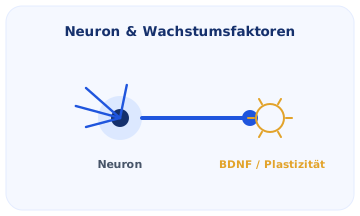
The manufacturer and part of the literature postulate neurotrophic effects intended to mimic endogenous neurotrophic factors (e.g. BDNF, GDNF, NGF, CNTF), as well as neuroprotective and neuroplasticity-promoting effects. This portrayal should be understood as a marketing claim or hypothesis: the precise molecular mechanism of action of a complex mixture derived from brain tissue is not conclusively established and not clearly proven.
As a biological mixture derived from brain tissue, the preparation is subject to batch-related heterogeneity; the precise composition and the active constituents are not fully characterised in a standardised manner, which complicates the comparison of studies.
Research history
Cerebrolysin (development code FPF-1070) has been produced for decades by the Austrian manufacturer EVER Pharma / EVER Neuro Pharma and has a long history of marketing and use in certain countries (particularly Eastern Europe, Russia, parts of Asia, and Latin America). It is not approved in the USA or the United Kingdom.
Positive aspects
What the research shows that is promising
Research areas
- Acute ischaemic stroke – the best-studied area of application; the 2023 Cochrane review finds, with moderate certainty, probably no benefit on mortality and a rather increased risk of serious non-fatal adverse events.
- Vascular dementia – the 2019 Cochrane review describes possible improvements in cognition and general function, but with a high risk of bias, marked heterogeneity, and without definitive significance.
- Alzheimer's dementia – individual studies (FPF-1070) investigated cognitive endpoints; the evidence is considered limited and not conclusive for a clinically relevant benefit.
- Traumatic brain injury (TBI) and other neurological diseases – partly investigated, but with methodologically limited, inconclusive data; preclinical or small studies do not replace proof of efficacy in humans.
Documented effects (from the literature)
- Adverse effects reported in studies and prescribing information include, among others, nausea, dizziness, headache, and sweating, particularly in connection with parenteral administration.
- The 2023 Cochrane stroke review reports that the add-on administration rather increases the number of serious, non-fatal adverse events, while overall mortality probably remains unaffected.
- Prescribing information lists contraindications, including in epilepsy, severe renal impairment, and hypersensitivity to constituents.
Risk analysis
What to view critically and honestly
Regulatory status by region
There is no central EMA marketing authorisation. Availability arises from the national regulations of individual member states and is not uniform across the EU.
Cerebrolysin is not an approved medicine in the USA and is not regularly marketed there; any distribution occurs at most through unregulated channels.
The approval and regulatory status varies greatly between countries; approval in one country does not mean that the benefit is considered proven by the standards of high-quality evidence-based reviews (e.g. Cochrane).
Safety concerns & caution
- Inconsistent evidence that is unconvincing on central endpoints: Cochrane finds, with moderate certainty, no mortality benefit in stroke; in vascular dementia the evidence is of low certainty and not definitive.
- Several key studies were (co-)funded by the manufacturer, which according to the Cochrane authors' assessment may have influenced design, conduct, and reporting (conflict-of-interest/bias risk).
- Porcine (pig-brain) origin: a biological mixture derived from animal brain tissue that is heterogeneous due to batch variation and not fully characterised.
- A heterogeneous, biologically complex product complicates standardisation, reproducibility, and the comparison of study results.
Risks of gray-market purchase
- In countries without approval (e.g. the USA, and largely also the part of the EU where it is not nationally approved), Cerebrolysin may be offered through unregulated online and grey-market channels – without official quality, identity, or purity controls.
- With grey-market goods there are risks regarding counterfeiting, contamination, mislabelling, and improper storage; the origin and actual content are often not verifiable.
- Promotion as a "nootropic" or performance enhancer for self-administration contradicts its status as a prescription medicine requiring medical supervision in the countries where it is approved.
Frequently asked questions
Is it proven that Cerebrolysin helps in stroke?
No, a convincing benefit is not proven. The 2023 Cochrane systematic review (Ziganshina et al.) concludes, with moderate certainty, that Cerebrolysin probably does not reduce overall mortality in acute ischaemic stroke and rather increases the number of serious, non-fatal adverse events. Several studies were manufacturer-funded, which further limits the significance.
Does Cerebrolysin help in vascular dementia?
The 2019 Cochrane review (Cui et al.) describes possible improvements in cognition and general function with no indication of relevant adverse effects, but expressly emphasises a high risk of bias, marked heterogeneity, and that the data are not definitive. If a benefit exists, it could be too small to be clinically meaningful. Meaningful, sufficiently large studies are lacking.
Is Cerebrolysin approved in Germany, the EU, or the USA?
There is no central EMA authorisation for the EU and no FDA approval for the USA. In individual countries (e.g. Austria) it is nationally available as a prescription medicine. Worldwide it is, according to the manufacturer, approved in around 50 countries, but the status varies greatly.
What is Cerebrolysin made of?
It is a mixture derived from porcine (pig) brain consisting of low-molecular-weight peptides (approx. 15%, < 10 kDa) and free amino acids (approx. 85%). As a biological mixture from brain tissue, it is heterogeneous due to batch variation and not fully characterised in a standardised manner.
Is Cerebrolysin a safe "nootropic" for self-administration?
This page gives no usage recommendations. In the countries where it is approved, Cerebrolysin is a prescription medicine requiring medical supervision, with documented adverse effects and contraindications. In countries without approval it also circulates through unregulated grey-market channels with risks regarding counterfeiting, contamination, and quality. Promotion as a harmless self-administration nootropic does not match the evidence and regulatory situation.
Sources
Primary and reference sources for your own reading.
- Cochrane Database of Systematic ReviewsCerebrolysin for acute ischaemic stroke (Cochrane Systematic Review, Ziganshina et al., 2023)
- PubMed / Cochrane Database of Systematic ReviewsCerebrolysin for acute ischaemic stroke (CD007026, pub7) – PubMed-Eintrag
- Cochrane Database of Systematic ReviewsCerebrolysin for vascular dementia (Cochrane Systematic Review, Cui et al., 2019)
- WikipediaCerebrolysin – Zusammensetzung, Hersteller (EVER Pharma), FPF-1070 und Regulierungsstatus
- Drugs.comCerebrolysin (International) – internationale Verfügbarkeit und Handelsstatus
Related substances
Unfamiliar terms? Look them up in the glossary or read the fundamentals.
This profile is for information and education only. It is not medical advice and deliberately contains no dosing or usage details. Decisions about use belong in a doctor’s hands.