Beginner view — everything explained simply.
Machine-assisted translation — the German original version is authoritative.

Growth hormone system
Ipamorelin
NNC 26-0161 · Ipamorelin-Pentapeptid · selektives GH-Sekretagogum (GHRP)
Ipamorelin is a synthetic pentapeptide that was described at Novo Nordisk in the late 1990s as the "first selective growth hormone secretagogue." It activates the ghrelin receptor (GHS-R1a) of the pituitary gland and stimulates a pulsatile release of growth hormone (GH) — according to the original preclinical work without any notable increase in cortisol, ACTH or prolactin, unlike older GHRPs. Despite this selectivity, ipamorelin was never approved as a medicine: clinical development, among other things against postoperative bowel obstruction (ileus), was discontinued. Today it circulates primarily as a gray-market "research peptide" and is banned in sport.
Regulatory status
Not approved for humans
Not approved as a medicine — a research/gray-market substance without an established safety profile in humans.
Drug class
Selective growth hormone secretagogue / ghrelin receptor (GHS-R1a) agonist (growth hormone-releasing peptide, GHRP)
Half-life (informative)
In the literature the elimination half-life is described as short (on the order of a few hours, frequently given as ~2 hours). Robust, broadly published human data are limited.
Studied in the literature
In preclinical and clinical investigations ipamorelin was administered parenterally (subcutaneously in animal models, intravenously in the Phase II ileus study). This describes solely how the substance was studied and is not an instruction for use.
Mechanism of action
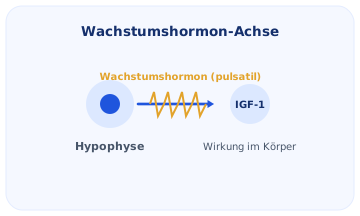
Ipamorelin binds as an agonist to the growth hormone secretagogue receptor (GHS-R1a, the ghrelin receptor) in the pituitary gland and the hypothalamus and triggers a pulsatile release of growth hormone (GH) from the somatotroph cells. In the original preclinical work by Raun et al. (1998), the substance was regarded as particularly selective: it released GH to an extent comparable to GHRH, but — unlike the older peptides GHRP-2 and GHRP-6 — did not raise ACTH and cortisol significantly above the GHRH level; FSH, LH, prolactin and TSH remained unaffected in these models. This selectivity is well documented in animal and in vitro models; however, no clinical benefit in humans was derived from it.
The much-cited "selectivity" stems predominantly from preclinical models (including pig and rat) and in vitro data. A preclinically clean profile proves no benefit or safety in humans — the only published clinical study targeted the gastrointestinal tract (ileus), not "anti-aging" or body composition.
Research history
Ipamorelin (development code NNC 26-0161) was developed at Novo Nordisk in the late 1990s and characterized in 1998 in a paper by Raun and colleagues in the European Journal of Endocrinology as the "first selective growth hormone secretagogue." It never reached approval as a medicine. Helsinn Therapeutics later investigated the substance in a placebo-controlled Phase II study (NCT00672074) for the treatment of postoperative bowel obstruction (ileus) following abdominal surgery; the study was completed, but convincing evidence of efficacy failed to materialize, and development for this indication was discontinued. Since then ipamorelin has had no approved field of application; it spreads predominantly as a gray-market research peptide.
Positive aspects
What the research shows that is promising
Research areas
- Characterization of the selectivity of GH secretagogues (preclinical, Raun et al. 1998)
- Pulsatile-physiological stimulation of the growth hormone axis (animal/in vitro models)
- Postoperative bowel obstruction (ileus) — Phase II clinical investigation, without approval success
- Gastrointestinal motility as a ghrelin receptor effect (preclinical)
Documented effects (from the literature)
- In preclinical models: dose-dependent release of growth hormone without a significant increase in ACTH, cortisol, prolactin, FSH, LH or TSH (Raun et al. 1998).
- As a ghrelin receptor agonist, effects on appetite and gastrointestinal motility have been described.
- Observations reported from non-clinical use (anecdotal, uncontrolled) include, among others, water retention, headaches and injection-site reactions — these are not to be regarded as robust safety data.
Risk analysis
What to view critically and honestly
Regulatory status by region
Ipamorelin is not approved as a medicine in the EU and has no ATC code. Distribution as a "research peptide" takes place outside medicines law; medicinal use in humans is not established.
No FDA approval for any indication. The Phase II clinical development against postoperative ileus (NCT00672074) was ended without approval. The FDA has critically assessed GH secretagogues/peptides of this kind and warned of the risks of gray-market preparations; ipamorelin is marketed predominantly as a research chemical.
The World Anti-Doping Agency (WADA) lists ipamorelin by name on the Prohibited List under category S2 (peptide hormones, growth factors, related substances and mimetics), in the section on growth hormone secretagogues/GHRP. The substance is prohibited at all times (in and out of competition).
Safety concerns & caution
- Very limited controlled human data; the only published clinical study targeted ileus and not the popularly advertised purposes.
- Long-term safety in humans is not established — no data on chronic use.
- Interventions in the GH/IGF-1 axis can theoretically affect glucose metabolism and insulin sensitivity; persistently elevated GH/IGF-1 levels have not been conclusively clarified with regard to long-term risks.
- The "selectivity" emphasized in marketing texts stems from animal models and is no proof of safety or benefit in humans.
Risks of gray-market purchase
- Sale as a "research peptide" or "not for human use" — outside any pharmaceutical-law quality assurance.
- Purity, identity, dose content and sterility are unsecured; impurities (e.g. bacterial endotoxins/LPS) and mislabeling are possible.
- Advertising claims about "anti-aging," muscle building or fat loss are marketing claims, not facts substantiated by human studies.
- Prohibited in sport at all times (WADA S2) — detection in urine samples is possible; a violation can have considerable consequences under sports law.
Frequently asked questions
What does "selective growth hormone secretagogue" mean in the case of ipamorelin?
In the original preclinical work (Raun et al. 1998), ipamorelin released growth hormone without — unlike older peptides such as GHRP-2 or GHRP-6 — raising cortisol, ACTH or prolactin to any notable extent. This selectivity is described in animal and in vitro models. It says nothing about benefit or safety in humans.
Is ipamorelin approved as a medication?
No. Ipamorelin is approved as a medicine neither in the EU nor in the USA. A Phase II clinical study against postoperative bowel obstruction (ileus) was completed but did not lead to approval; development was discontinued. No approved field of application exists.
How does this profile differ from "CJC-1295 + Ipamorelin"?
This profile describes ipamorelin as a single substance — its origin at Novo Nordisk, the selectivity research and the discontinued ileus development. The separate profile "CJC-1295 + Ipamorelin" deals with the combination common in the scene with a GHRH analogue, which acts at a different point of the GH axis.
Is ipamorelin permitted in sport?
No. WADA lists ipamorelin by name on the Prohibited List under category S2 (growth hormone secretagogues). The substance is prohibited at all times — in and out of competition.
Sources
Primary and reference sources for your own reading.
- PubMedRaun et al.: „Ipamorelin, the first selective growth hormone secretagogue“ (Eur J Endocrinol, 1998)
- ClinicalTrials.govPhase-II-Studie: Safety and Efficacy of Ipamorelin for Management of Post-Operative Ileus (NCT00672074)
- WikipediaIpamorelin — Übersicht (NNC 26-0161, Novo Nordisk, Status, Pharmakologie)
- World Anti-Doping AgencyWADA — The Prohibited List (Ipamorelin namentlich unter S2)
Related substances
Unfamiliar terms? Look them up in the glossary or read the fundamentals.
This profile is for information and education only. It is not medical advice and deliberately contains no dosing or usage details. Decisions about use belong in a doctor’s hands.