Beginner view — everything explained simply.
Machine-assisted translation — the German original version is authoritative.

Longevity & Immune System
Thymalin
Thymalin · Thymus-Peptidfraktion · Thymus-Peptidpräparat · Thymalinum · Khavinson-Thymuspeptid
Thymalin is a peptide preparation derived from the thymus gland (typically from calves), studied predominantly by Russian research groups around Vladimir Khavinson at the St. Petersburg Institute of Bioregulation and Gerontology. It is investigated in the context of immunomodulation and "anti-aging" ("geroprotection"). However, the body of evidence stems largely from a single research tradition, is in part methodologically dated, and has barely been independently replicated in the West. Thymalin is not approved as a medicinal product in the EU or the USA; in Russia it has been used since the Soviet era and is registered there. The advertised longevity and immune effects should be classified as claims, not as established knowledge.
Regulatory status
Not approved for humans
In the EU and the USA, Thymalin is not approved as a medicinal product; in Russia it is used and registered there. Outside Russia, it should be classified as an experimental substance.
Drug class
Thymus peptide preparation (heterogeneous peptide fraction of animal origin)
Half-life (informative)
Not clearly defined; for a heterogeneous peptide mixture, no reliable, uniform half-life can be given. Purely descriptive, no dosing information.
Studied in the literature
In the underlying studies, Thymalin was investigated predominantly parenterally (as an injection) in humans or animal models, as well as in cell culture (in vitro). This describes solely HOW it was studied in research – it is not a usage instruction.
Mechanism of action
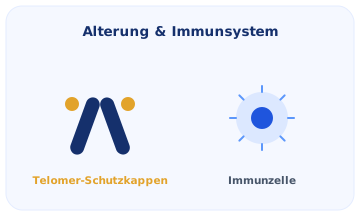
An immunomodulating or "thymus-regulating" effect is advertised. As a possible molecular background, short peptides (e.g., the dipeptides KE and EW as well as EDP) within the fraction are discussed, which are said to bind to double-stranded DNA and histone proteins and thereby influence gene expression. In vitro (e.g., in the human monocyte/macrophage cell line THP-1), anti-inflammatory effects and an influence on cell proliferation and cytokines have been described. Overall, it holds that the exact mechanism of action is not well established by modern standards; much remains hypothetical or preclinical.
It is a heterogeneous peptide fraction extracted from animal tissue, whose exact composition can vary from batch to batch. A large part of the literature is older, stems from a single research tradition, and does not consistently meet today's methodological standards (randomization, blinding, independent replication).
Research history
Thymus peptide research goes back to work by Vladimir Khavinson (V. Kh. Khavinson) and colleagues (including V. G. Morozov) starting in the 1970s, in the environment of the St. Petersburg Institute of Bioregulation and Gerontology. Thymalin emerged from the Soviet/Russian tradition of "peptide bioregulators." A frequently cited part of this work – such as an observation in older individuals running over several years – is published by the originating group itself; independent Western confirmation has largely been lacking.
Positive aspects
What the research shows that is promising
Research areas
- Immunomodulation / immunosenescence (age-related weakening of the immune system) – predominantly in work by the originating group; quality of evidence limited.
- "Geroprotection" / longevity – advertised on the basis of long-term observations in older individuals, but without independent replication; to be classified as a claim, not as proven.
- Inflammation and cytokine regulation – described in vitro (e.g., THP-1 cells); preclinical, not equivalent to a demonstrated benefit in humans.
- Supportive immunomodulation in infections (including COVID-19) – smaller, partly non-blinded studies from the same research environment; preliminary and not independently confirmed.
Documented effects (from the literature)
- The available safety data stem predominantly from older or limited studies of a single research tradition and do not allow a comprehensive risk assessment by today's standards.
- In the original work, the preparation tends to be described as well tolerated; robust, independently collected data on side effects, however, are largely lacking.
- As an animal tissue extract, allergic or immunological reactions are in principle conceivable – systematic modern data on this are lacking.
Risk analysis
What to view critically and honestly
Regulatory status by region
No approval as a medicinal product; no regulatory benefit-risk assessment according to EU standards.
No FDA approval; partly marketed as a "research peptide," which does not replace a regulatory review.
Used or registered in Russia since the Soviet era; in most other countries without approval and therefore experimental.
Safety concerns & caution
- Very limited independent replication: A large part of the positive findings stems from the environment of the originating group (Khavinson); Western confirmation is largely lacking.
- Methodological weaknesses: frequently older methodology, open (non-blinded) designs, in part non-randomized comparison groups – this strongly limits the validity.
- Unknown long-term safety; no modern regulatory benefit-risk assessment in the EU/USA.
- Heterogeneous, batch-dependent composition of an animal extract makes reproducible statements difficult.
Risks of gray-market purchase
- Marketing as a "research peptide": Such products are not subject to medicinal product control; purity, identity, and content are not guaranteed by authorities.
- Possible contaminants (e.g., endotoxins/LPS) or mislabeling from unregulated sources.
- Advertising claims about "anti-aging," immune strengthening, or life extension should be classified as unproven claims, not as established facts ("is advertised as…" – "claim, not proven").
Frequently asked questions
Is the effect of Thymalin scientifically proven?
No – not in the sense of modern, independently confirmed evidence. Most positive findings stem from a single Russian research tradition (Khavinson) and have barely been replicated in the West. Many studies are methodologically older or non-blinded. Advertised longevity and immune effects should therefore be classified as claims, not as established knowledge.
Is Thymalin approved as a medication?
In the EU and the USA, Thymalin is not approved as a medicinal product. In Russia it has been used since the Soviet era and is registered there. Outside Russia it is considered an experimental substance without a regulatory benefit-risk assessment.
What does the reported "reduction in mortality" in older people mean?
A widely cited observation by the originating group reported a lower mortality in the Thymalin group over several years. However, this work stems from the same research environment, is in part non-randomized/non-blinded, and has not been independently confirmed. Such results should therefore be interpreted with great caution and not be understood as a proven benefit.
What is Thymalin made of?
It is a heterogeneous peptide fraction extracted from the thymus gland (mostly from calves). Short peptides such as the dipeptides KE and EW are discussed as possibly active components. The exact composition can vary from batch to batch.
Are there risks with gray-market "research peptides"?
Yes. Products sold as "research peptides" are not subject to medicinal product control. Purity, identity, and content are not guaranteed; contaminants (e.g., endotoxins) are possible. Advertising claims do not replace a regulatory review.
Sources
Primary and reference sources for your own reading.
- PubMed (Neuroendocrinology Letters)Khavinson VKh, Morozov VG. Peptides of pineal gland and thymus prolong human life. Neuro Endocrinol Lett. 2003.
- PMC (International Journal of Molecular Sciences)Avolio F, Martinotti S, Khavinson VKh, et al. Peptides Regulating Proliferative Activity and Inflammatory Pathways in the Monocyte/Macrophage THP-1 Cell Line. Int J Mol Sci. 2022. (In-vitro-Studie, u. a. mit Thymalin)
- Springer / Advances in GerontologyKuznik BI, Khavinson VKh, Shapovalov KG, et al. Peptide Drug Thymalin Regulates Immune Status in Severe COVID-19 Older Patients. Advances in Gerontology. 2021.
- PMC (International Journal of Molecular Sciences)The Influence of KE and EW Dipeptides in the Composition of the Thymalin Drug on Gene Expression and Protein Synthesis Involved in the Pathogenesis of COVID-19 (mechanistische/in-silico- bzw. molekulare Analyse).
Related substances
Unfamiliar terms? Look them up in the glossary or read the fundamentals.
This profile is for information and education only. It is not medical advice and deliberately contains no dosing or usage details. Decisions about use belong in a doctor’s hands.