Beginner view — everything explained simply.
Machine-assisted translation — the German original version is authoritative.

Skin & Cosmetics
GHK-Cu
Kupfer-Tripeptid-1 · Copper Peptide · Glycyl-L-Histidyl-L-Lysin:Cu
GHK-Cu is a naturally occurring, copper-binding tripeptide. Its plasma level declines with age. In cosmetics it is established as a topical ingredient (creams, serums) and is associated with skin regeneration. An injectable use as a medicine is not approved.
Regulatory status
Cosmetic ingredient (topical)
Established as a topical cosmetic ingredient — not approved as an injectable medicine.
Drug class
Copper-binding tripeptide (cosmetic active ingredient)
Half-life (informative)
Short in plasma; topically, the local effect on the skin is what matters.
Studied in the literature
Predominantly investigated and used topically (cosmetics). Injectable use is not established/approved as a medicine.
Mechanism of action
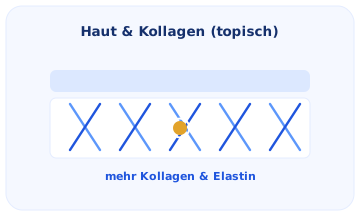
GHK forms a complex with copper(II) and is involved in signaling processes of tissue remodeling, wound healing and antioxidation. In cell and skin models, effects on collagen, elastin and repair genes are described. Topically it is a widely used anti-aging ingredient.
The copper component is functionally relevant but makes quality and formulation especially important.
Research history
Described in 1973 by Loren Pickart as a plasma factor that influences tissue regeneration. Since then investigated primarily in skin research and cosmetics.
Positive aspects
What the research shows that is promising
Research areas
- Skin regeneration and anti-aging (topical)
- Wound healing (research)
- Hair/scalp research
- Tissue-protective regeneration across organs (e.g. nerve, lung, liver tissue) (preclinical)
Documented effects (from the literature)
- Generally well tolerated topically.
- In skin models, effects on collagen/elastin and repair pathways.
Risk analysis
What to view critically and honestly
Regulatory status by region
Widely used as "Copper Tripeptide-1" in cosmetic products. No approval as an injectable medicine.
Widely used in skin care. Injectable "research" use is not approved.
Safety concerns & caution
- Injectable use is not established/investigated — safety for it is not established.
- Copper excess is fundamentally not harmless; formulation and purity matter.
- On sensitive skin, local reactions are possible topically.
Risks of gray-market purchase
- Injectable "GHK-Cu research" vials are neither tested nor intended for this use.
- Purity, sterility and actual copper content are unassured in gray-market products.
Frequently asked questions
What is GHK-Cu usually used for?
Primarily topically in skin care (serums, creams) in an anti-aging context.
Is the cosmetic use the same as an injection?
No. The established, regulated use is topical. Injectable applications are not approved as a medicine and are not equivalent.
Sources
Primary and reference sources for your own reading.
Related substances
Mentioned in these guide articles
Unfamiliar terms? Look them up in the glossary or read the fundamentals.
This profile is for information and education only. It is not medical advice and deliberately contains no dosing or usage details. Decisions about use belong in a doctor’s hands.