

Beginner view — everything explained simply.
Machine-assisted translation — the German original version is authoritative.

Skin & Cosmetics
Argireline (Acetyl Hexapeptide-8)
Acetyl Hexapeptide-3 · Acetyl Hexapeptide-8
Argireline is a cosmetic peptide used topically in serums and creams to soften the depth of expression lines. It is an established cosmetic ingredient — not an injectable medicine.
Regulatory status
Cosmetic ingredient (topical)
Established topical cosmetic ingredient — not a medicine.
Drug class
Cosmetic peptide (SNAP-25 mimetic)
Half-life (informative)
Not decisive for topical cosmetics — what is relevant is the local effect on the skin.
Studied in the literature
Investigated and used topically in cosmetic formulations.
Mechanism of action
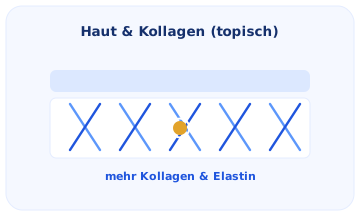
Argireline mimics the N-terminal end of the protein SNAP-25 and competes with it for a place in the SNARE complex, which controls the release of acetylcholine at the synapses of the facial muscles. If this complex is destabilized, the signal transmission to the muscle is meant to be dampened, which slightly relaxes the muscles of facial expression. The strength of the effect of topical use is considered moderate and is discussed in the literature.
The penetration of topically applied peptides, and thus the strength of the effect, is a debated topic.
Research history
Introduced as a cosmetic active ingredient and widely used in numerous anti-aging products. Clinical cosmetic studies describe a measurable but limited reduction in wrinkle depth.
Positive aspects
What the research shows that is promising
Research areas
- Expression lines / anti-aging (topical)
- Cosmetic active-ingredient research
Documented effects (from the literature)
- Generally well tolerated topically.
- The described wrinkle smoothing is moderate and formulation-dependent.
Risk analysis
What to view critically and honestly
Regulatory status by region
Widely used in skin-care products. No approval/suitability as an injectable medicine.
Safety concerns & caution
- Efficacy claims ("Botox alternative") often go beyond the body of data.
- On sensitive skin, local reactions are possible.
Risks of gray-market purchase
- Concentration and formulation quality determine the effect — unassured in cheap products.
Frequently asked questions
Is Argireline a "Botox alternative"?
It is marketed that way, but the mechanism of action (topical, superficial) and the strength of the effect differ markedly. It is a cosmetic ingredient, not a medicine.
Do you have to inject it?
No. It is intended for topical application in skin-care products.
How do I recognize a reputable Argireline product?
What matters is a traceable INCI declaration (Acetyl Hexapeptide-8 or -3), a plausible concentration figure and an established cosmetics manufacturer with quality control. Loose raw powder from the gray market without verified purity and without a finished formulation is unsuitable for this — effect and skin tolerability depend heavily on the formulation.
Sources
Primary and reference sources for your own reading.
Related substances
Unfamiliar terms? Look them up in the glossary or read the fundamentals.
This profile is for information and education only. It is not medical advice and deliberately contains no dosing or usage details. Decisions about use belong in a doctor’s hands.