

Beginner view — everything explained simply.
Machine-assisted translation — the German original version is authoritative.

Metabolism & Weight
Dulaglutid
Trulicity · LY2189265 · Dulaglutide
Dulaglutide is a long-acting agonist at the receptor of glucagon-like peptide-1 (GLP-1), developed by the pharmaceutical company Eli Lilly under the brand name “Trulicity”. It is a genetically engineered fusion protein: two modified GLP-1 analogues are linked via connectors to a fragment (Fc portion) of a human antibody (IgG4). This construction slows down degradation and renal excretion so substantially that once-weekly subcutaneous administration becomes possible. Dulaglutide is approved as a prescription medicine in the EU and the USA for the treatment of type 2 diabetes; in the USA there is an additional approval for the reduction of cardiovascular events. Its efficacy was investigated in the extensive AWARD trial programme and its cardiovascular effects in the large REWIND trial. Dulaglutide is not a substance for self-administration; its use takes place exclusively under medical prescription and supervision. This page serves informational and educational purposes only.
Regulatory status
Approved · prescription-only
Prescription medicine approved in the EU and USA – not a substance for self-administration.
Drug class
GLP-1 receptor agonist (incretin mimetic); long-acting Fc fusion protein
Half-life (informative)
The half-life is in the range of about five days, which enables the once-weekly administration interval. Specific quantity, dose, or application details are deliberately not provided here.
Studied in the literature
In the clinical trials (AWARD programme, REWIND), dulaglutide was administered subcutaneously (under the skin). This describes solely how the active substance is investigated in research and in the approved therapy, and is not an instruction for use. Use takes place exclusively following medical prescription and guidance.
Mechanism of action
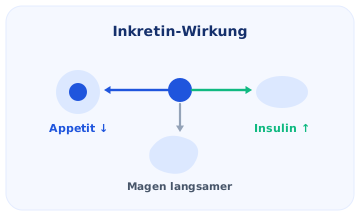
Dulaglutide mimics the action of the body's own intestinal hormone GLP-1 and binds to the GLP-1 receptor. This stimulates – in a glucose-dependent manner – the insulin secretion of the beta cells of the pancreas and dampens the release of the counter-regulatory hormone glucagon. Because the effect is glucose-dependent, the risk of hypoglycaemia from the active substance itself is comparatively low. In addition, dulaglutide slows gastric emptying and acts on receptors in the central nervous system to reduce appetite, which contributes to a feeling of satiety and tends to promote weight loss. The attached Fc portion of the antibody enlarges the molecule and protects it from rapid enzymatic degradation by the enzyme DPP-4 as well as from rapid excretion via the kidneys – this explains the long duration of action and the once-weekly administration interval.
As a large fusion protein, dulaglutide is not absorbed via the gastrointestinal tract and is not orally available. Degradation presumably occurs via general protein degradation pathways (protein catabolism) into the body's own amino acids.
Research history
Dulaglutide was developed by Eli Lilly and Company (development code LY2189265). Its efficacy and safety were investigated in the phase 3 trial programme AWARD (Assessment of Weekly AdministRation of LY2189265 in Diabetes). The US regulatory authority FDA granted initial approval in September 2014; in the same year the centralised marketing authorisation in the European Union followed via the European Medicines Agency (EMA). The large cardiovascular outcome trial REWIND randomised a total of 9,901 people with type 2 diabetes between 2011 and 2013; its results were published in 2019 and showed a reduction in major cardiovascular events. On this basis, the indication in the USA was expanded to include the reduction of cardiovascular risk.
Positive aspects
What the research shows that is promising
Research areas
- Treatment of type 2 diabetes mellitus to improve glycaemic control (HbA1c reduction; AWARD trial programme)
- Reduction of major cardiovascular events (MACE) in type 2 diabetes with cardiovascular risk (REWIND trial)
- Influence on body weight through appetite reduction and slowed gastric emptying
- Exploratory analyses of stroke risk and cardiovascular endpoints (REWIND sub-analyses)
- Comparison with other glucose-lowering agents (e.g. metformin, insulin glargine, exenatide, sitagliptin)
Documented effects (from the literature)
- Frequent gastrointestinal complaints: nausea, vomiting, diarrhoea, abdominal pain, loss of appetite – especially at the start of treatment.
- Glucose-dependent effect: low risk of hypoglycaemia from the active substance alone, but increased risk of hypoglycaemia in combination with insulin or sulfonylureas.
- In the REWIND trial, a reduction in major cardiovascular events was observed; this is a documented trial result in the patient group studied.
- Weight loss was observed in trials.
Risk analysis
What to view critically and honestly
Regulatory status by region
Approved since 2014 via the EMA in the centralised procedure as Trulicity for the treatment of type 2 diabetes. Dispensing exclusively on medical prescription.
Initial FDA approval in 2014 (Trulicity) for type 2 diabetes; later expansion to the reduction of major cardiovascular events in certain patients. The FDA prescribing information contains a Boxed Warning regarding thyroid C-cell tumours.
Dulaglutide is available as a prescription diabetes medication in many countries. Regulatory status and indications may vary from country to country.
Safety concerns & caution
- Diseases of the gallbladder and bile ducts (including gallstones, cholecystitis) have been reported.
- Risk of acute inflammation of the pancreas (pancreatitis); if corresponding symptoms occur, use should be discontinued and clarified medically.
- In animal studies (rats), dulaglutide caused thyroid C-cell tumours in a dose- and treatment-duration-dependent manner. Whether this is transferable to humans is not clarified – the FDA prescribing information contains a Boxed Warning on this.
- Contraindicated in persons with a personal or family history of medullary thyroid carcinoma (MTC) as well as in multiple endocrine neoplasia type 2 (MEN 2).
- Possible impairment of kidney function, particularly in connection with pronounced nausea, vomiting, or diarrhoea and fluid deficiency.
- Dulaglutide is not suitable for self-medication; indication, prescription, and monitoring belong in medical hands.
Risks of gray-market purchase
- For GLP-1 receptor agonists, counterfeit products are documented: in 2023/2024 the EMA and WHO warned of falsified pens that were incorrectly labelled as Ozempic (semaglutide) and in some cases contained a different active substance (e.g. insulin) instead of the one declared – with the risk of severe hypoglycaemia.
- Goods obtained via the grey or black market or offered as a “research chemical” may be contaminated, incorrectly dosed, without active substance, or with the wrong active substance; identity, purity, and sterility are not assured.
- Promotional claims from unregulated sources (such as about weight loss or “anti-ageing”) are to be understood as claims – unproven – and are not to be equated with the medically prescribed, approved use.
- An approved, quality-tested medicine is provided exclusively via regular, medically prescribed channels; obtaining it outside these channels bypasses every regulatory quality and safety control.
Frequently asked questions
What is dulaglutide and what is it used for?
Dulaglutide (brand name Trulicity) is a long-acting GLP-1 receptor agonist from Eli Lilly. It is approved as a prescription medicine in the EU and the USA for the treatment of type 2 diabetes; in the USA there is an additional approval for the reduction of cardiovascular events. This page is purely informational – it is not an instruction for use or therapy.
How does dulaglutide differ from short-acting GLP-1 agents?
Dulaglutide is structured as a fusion protein: GLP-1 analogues are coupled to an antibody Fc portion. This enlarges the molecule, protects it from rapid degradation and from rapid excretion via the kidneys. This makes once-weekly administration possible, whereas short-acting agents have to be applied more frequently.
Which side effects and risks are documented?
The most common are gastrointestinal complaints such as nausea, vomiting, and diarrhoea, especially at the start. Gallbladder diseases and a risk of inflammation of the pancreas have also been reported. In rat studies, thyroid C-cell tumours occurred, which is why the FDA prescribing information contains a warning and the active substance is contraindicated in cases with a history of medullary thyroid carcinoma or MEN 2. Assessment in the individual case belongs in medical hands.
Why are there warnings about counterfeit GLP-1 products?
Because of the high demand for GLP-1 agents, counterfeit products have appeared. In 2023/2024 the EMA and WHO warned of falsified pens that were passed off as Ozempic (semaglutide) and in some cases contained a different, dangerous active substance. Goods obtained via unofficial channels are not guaranteed in identity, purity, and safety. Approved medicines are provided exclusively via regular, medically prescribed channels.
Sources
Primary and reference sources for your own reading.
- U.S. National Library of Medicine / FDA (DailyMed)TRULICITY (dulaglutide) injection – FDA-Fachinformation (DailyMed), inkl. Boxed Warning zu Schilddrüsen-C-Zell-Tumoren und Kontraindikation bei MTC/MEN 2
- The Lancet (PubMed-verlinkte Stroke-Subanalyse; Lancet Diabetes Endocrinol)Dulaglutide and cardiovascular outcomes in type 2 diabetes (REWIND): a double-blind, randomised placebo-controlled trial
- Diabetes/Metabolism Research and Reviews (Wiley), 2016Efficacy and safety of dulaglutide in the treatment of type 2 diabetes: a comprehensive review of the dulaglutide clinical data focusing on the AWARD phase 3 clinical trial program
- Diabetes Care (American Diabetes Association), via PubMedEfficacy and safety of dulaglutide added onto pioglitazone and metformin versus exenatide in type 2 diabetes (AWARD-1)
- European Medicines Agency (EMA)EMA alerts EU patients and healthcare professionals to reports of falsified Ozempic pens (GLP-1-Rezeptoragonisten – Fälschungswarnung)
Related substances
Unfamiliar terms? Look them up in the glossary or read the fundamentals.
This profile is for information and education only. It is not medical advice and deliberately contains no dosing or usage details. Decisions about use belong in a doctor’s hands.