

Beginner view — everything explained simply.
Machine-assisted translation — the German original version is authoritative.

Metabolism & Weight
Liraglutid
Victoza · Saxenda · Liraglutide · NN2211
Liraglutide is a bioengineered analogue of the body's own gut hormone GLP-1 (Glucagon-like Peptide-1), sharing roughly 97% homology with human GLP-1. By attaching a fatty-acid chain, it binds to albumin in the blood, is broken down more slowly, and therefore acts for about a day. It lowers blood glucose in a glucose-dependent manner (enhanced insulin and reduced glucagon secretion), slows gastric emptying, and dampens appetite and feelings of hunger. Unlike most of the "research peptides" covered on this site, liraglutide is a thoroughly studied, approved medicine: as Victoza (type 2 diabetes) and as Saxenda (chronic weight management). The cardiovascular outcomes trial LEADER showed a benefit over placebo in type 2 diabetics at high risk. It is strictly prescription-only in the EU and USA, carries a US Boxed Warning over thyroid C-cell tumours in rodents, and is not a substance for self-administration.
Regulatory status
Approved · prescription-only
Approved in the EU and USA as a prescription-only medicine (Victoza for diabetes, Saxenda for obesity).
Drug class
GLP-1 receptor agonist (incretin mimetic), acylated GLP-1 analogue
Half-life (informative)
Descriptive note: The plasma half-life of liraglutide is around 13 hours after subcutaneous administration. It is more than 98% bound to plasma proteins (albumin); this binding, together with self-association at the injection site, slows absorption and breakdown. Degradation occurs through general proteolysis, without a single organ system dominating. No amounts, dosing or administration instructions.
Studied in the literature
In approval trials and clinical use, liraglutide was studied as a subcutaneous injection. This information describes solely how the substance was researched and medically used – it is expressly not an instruction for use. Administration belongs in medical hands in every case.
Mechanism of action
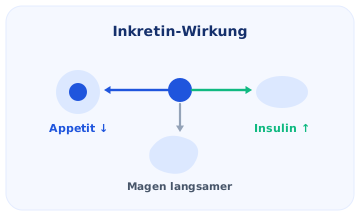
Liraglutide activates the GLP-1 receptor and thereby mimics the natural incretin hormone GLP-1. At the beta cells of the pancreas it increases insulin secretion in a glucose-dependent way (that is, primarily when blood glucose is elevated) while simultaneously reducing glucagon release. In addition, it slows gastric emptying and acts via areas of the central nervous system to reduce appetite and promote satiety, which explains the decreased food intake and weight loss. Structurally, liraglutide differs from the body's own GLP-1 through an amino-acid substitution and an attached C16 fatty-acid chain with a spacer; this enables self-association at the injection site and strong binding to albumin, which delays breakdown by the enzyme DPP-4 and prolongs the duration of action.
Liraglutide is a prescription medicine with extensive, officially reviewed product and patient information. Efficacy and safety depend on a doctor's indication, comorbidities, interactions and contraindications. This page is purely informative and does not replace medical advice.
Research history
Liraglutide was developed at the Danish company Novo Nordisk. The idea of using fatty-acid acylation to prolong the duration of action goes back to work by Lotte Bjerre Knudsen and colleagues in the mid-1990s; the molecule was selected for clinical development in 1997. Approval for type 2 diabetes followed under the name Victoza in 2009 in the EU (EMA) and in 2010 in the USA (FDA). A higher-dose variant for chronic weight management was approved under the name Saxenda in late 2014 (FDA) and in 2015 (EMA). Liraglutide is regarded as an important predecessor of the later-developed, longer-acting semaglutide.
Positive aspects
What the research shows that is promising
Research areas
- Type 2 diabetes mellitus (lowering blood glucose as an adjunct to diet and exercise)
- Chronic weight management / obesity
- Cardiovascular outcomes in high-risk diabetics (LEADER trial)
- Effect on appetite regulation, satiety and gastric emptying
- Studies on renal and metabolic parameters in type 2 diabetes
Documented effects (from the literature)
- Very common gastrointestinal side effects: nausea, diarrhoea, constipation, vomiting (in trials, nausea documented in roughly one third of those treated in some cases)
- Gastrointestinal complaints that frequently lead to treatment discontinuation, especially at the start
- Possible low blood sugar (hypoglycaemia), particularly in combination with other glucose-lowering agents
- Gallbladder disorders such as gallstones (cholelithiasis) and gallbladder inflammation (cholecystitis), more frequent in trials than under placebo
- In the LEADER trial, the composite cardiovascular endpoint (cardiovascular death, non-fatal heart attack or stroke) was lower under liraglutide than under placebo
Risk analysis
What to view critically and honestly
Regulatory status by region
Victoza (type 2 diabetes) approved EU-wide since 2009 (EMA); Saxenda (chronic weight management) since 2015. Dispensed only on a doctor's prescription.
Victoza approved by the FDA in 2010, Saxenda in late 2014. Both carry an FDA Boxed Warning regarding thyroid C-cell tumours.
Registered as a medicine in numerous countries. Authorities (including the FDA, EMA and WHO) nonetheless warn about counterfeit GLP-1 products from unregulated sources.
Safety concerns & caution
- Signal for acute pancreatitis (inflammation of the pancreas), including severe courses, under GLP-1 receptor agonists – medical evaluation is needed if suspected
- In animal studies (rats and mice), thyroid C-cell tumours occurred in a dose- and treatment-duration-dependent manner; whether a corresponding risk (medullary thyroid carcinoma, MTC) exists in humans is not conclusively established – the basis of the US Boxed Warning
- Contraindicated in people with a personal or family history of medullary thyroid carcinoma (MTC) as well as in multiple endocrine neoplasia type 2 (MEN 2)
- Possible increase in heart rate, dehydration as a result of gastrointestinal complaints, and interactions with other medicines
- Use requires a doctor's indication, counselling and monitoring; not suitable for self-administration
Risks of gray-market purchase
- Authorities such as the FDA, EMA and WHO have documented counterfeit GLP-1 products (including semaglutide/Ozempic) in the supply chain; the risks are transferable to the entire drug class
- An analysis published in the Journal of Medical Internet Research (2024) of semaglutide products sold online without a prescription classified all the samples examined as substandard and counterfeit – with drastically lower purity than stated, incorrect active-ingredient content, and contamination with endotoxins
- Falsely declared or contaminated products may contain other substances instead of the expected active ingredient; in documented cases, relabelled insulin was found, for example, which can trigger life-threatening hypoglycaemia
- Marketing promises from the grey market ("highest purity", "pharmaceutical quality") are unsubstantiated claims and not facts – without regulatory oversight, identity, sterility and dosing are not assured
- Risks from the lack of medical supervision: unrecognised contraindications (e.g. MTC/MEN 2), missed pancreatitis symptoms and delayed diagnosis of serious illnesses
Frequently asked questions
Is liraglutide the same as semaglutide or Ozempic?
No. Liraglutide (Victoza, Saxenda) and semaglutide (e.g. Ozempic, Wegovy) are related but distinct GLP-1 receptor agonists from the same manufacturer (Novo Nordisk). Liraglutide was developed earlier and is regarded as a predecessor; semaglutide is longer-acting. Both are prescription medicines.
What is liraglutide approved for?
In the EU and USA, liraglutide is approved as Victoza for the treatment of type 2 diabetes and as Saxenda for chronic weight management in obesity – in each case as an adjunct to diet and exercise and only on a doctor's prescription.
Why does liraglutide carry a warning about thyroid tumours?
In animal studies with rats and mice, thyroid C-cell tumours occurred in a dose- and duration-dependent manner. Whether a corresponding risk (medullary thyroid carcinoma) exists in humans is not conclusively established. As a precaution, the substance carries a Boxed Warning in the USA and is contraindicated in those with a personal or family history of MTC as well as in MEN 2.
What are the most common side effects?
The most common are gastrointestinal complaints such as nausea, diarrhoea, constipation and vomiting, especially at the start of treatment. Gallbladder disorders (e.g. gallstones) and a signal for pancreatitis have also been observed. Details and individual risks belong in medical hands.
Can I use liraglutide myself or buy it online?
No. Liraglutide is a prescription medicine and not a substance for self-administration. This page gives no sourcing or usage guidance. Authorities have also documented counterfeit GLP-1 products from unregulated online sources, whose content, purity and sterility are not assured.
Sources
Primary and reference sources for your own reading.
- New England Journal of Medicine / PubMedLiraglutide and Cardiovascular Outcomes in Type 2 Diabetes (LEADER-Studie)
- U.S. FDA / DailyMed (NLM)SAXENDA (liraglutide) injection – Prescribing Information (Boxed Warning, Contraindications, Nebenwirkungen)
- StatPearls / NCBI BookshelfLiraglutide – StatPearls (Wirkmechanismus, Pharmakokinetik, Sicherheit)
- ACS Pharmacology & Translational Science / PMCInventing Liraglutide, a Glucagon-Like Peptide-1 Analogue, for the Treatment of Diabetes and Obesity
- Journal of Medical Internet Research / PMCMultifactor Quality and Safety Analysis of Semaglutide Products Sold by Online Sellers Without a Prescription
Related substances
Mentioned in these guide articles
Unfamiliar terms? Look them up in the glossary or read the fundamentals.
This profile is for information and education only. It is not medical advice and deliberately contains no dosing or usage details. Decisions about use belong in a doctor’s hands.