Beginner view — everything explained simply.
Machine-assisted translation — the German original version is authoritative.

Metabolism & Weight
Exenatid
Byetta · Bydureon · Bydureon BCise · Exendin-4 · Exenatide · AC2993
Exenatide is a GLP-1 receptor agonist and the synthetic version of the peptide exendin-4, which was originally described in the saliva of the North American Gila monster (Heloderma suspectum). In 2005 it became the first drug approved in this class and was marketed under the brand names Byetta (twice daily) and Bydureon (extended release, once weekly) for the treatment of type 2 diabetes. Exenatide is now regarded as an older member of the GLP-1 class; in several markets commercial distribution has since been discontinued. This information is provided for educational purposes only and does not constitute instructions for use.
Regulatory status
Approved · prescription-only
A prescription-only, officially approved drug for the treatment of type 2 diabetes — but no longer commercially available in several markets.
Drug class
GLP-1 receptor agonist (incretin mimetic); 39-amino-acid peptide
Half-life (informative)
In pharmacological investigations, a short plasma half-life in the range of a few hours was described for the rapid-release form; the extended-release form was designed for a markedly longer duration of action. No dosing or quantity figures are deliberately given here.
Studied in the literature
In clinical trials, exenatide was studied as a subcutaneous injection (rapid-release as well as extended-release in microsphere form). This describes solely how the substance was researched and is not instructions for use.
Mechanism of action
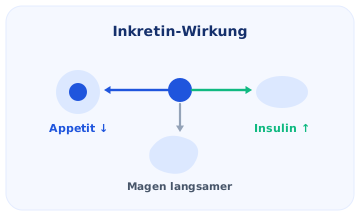
Exenatide acts as an agonist at the GLP-1 receptor and mimics the action of the body's own incretin hormone GLP-1 (glucagon-like peptide-1). In studies it has been described to produce a glucose-dependent increase in insulin secretion, inhibition of glucagon release, slowing of gastric emptying, and promotion of satiety. Unlike rapidly degraded human GLP-1, exenatide is largely resistant to the enzyme DPP-4, which in pharmacological investigations led to a longer duration of action. The molecule shares only about 53% of its amino acid sequence with human GLP-1.
DPP-4 resistance distinguishes exenatide from the body's own GLP-1 and was the basis for the longer duration of action. Exenatide is eliminated predominantly via the kidneys, which is why renal function is regarded as a relevant factor in research.
Research history
The underlying peptide exendin-4 was identified in the early 1990s (John Eng, 1992) in the saliva of the Gila monster (Heloderma suspectum). The synthetic form was developed by Amylin Pharmaceuticals (in cooperation with Eli Lilly). Byetta (exenatide twice daily) received FDA approval in the United States in 2005, making it the very first GLP-1 receptor agonist; EU approval followed in 2006. The extended-release formulation Bydureon (once weekly, PLGA microspheres) was approved in 2011/2012. Marketing rights later passed to Bristol-Myers Squibb and eventually to AstraZeneca. AstraZeneca informed the FDA that it had discontinued distribution of Byetta and Bydureon BCise in 2024.
Positive aspects
What the research shows that is promising
Research areas
- Blood glucose control in type 2 diabetes (HbA1c reduction) — approved indication
- Cardiovascular endpoints (EXSCEL trial: safety confirmed, primary superiority endpoint not met)
- Body weight and satiety (moderate weight loss observed in diabetes trials)
- Preclinical and early clinical research into neurodegenerative diseases (e.g. Parkinson's disease) — not approved, results inconsistent
Documented effects (from the literature)
- Gastrointestinal complaints (nausea, vomiting, diarrhea) as the most common adverse effects documented in studies, especially at the start
- Injection-site reactions (itching, redness)
- Low blood sugar (hypoglycemia), particularly in combination with certain other glucose-lowering agents
- Reduced appetite
Risk analysis
What to view critically and honestly
Regulatory status by region
EU approval was granted via the EMA. The status of individual brand names may change as a result of commercial decisions by the marketing authorization holder; availability must be assessed differently from country to country.
AstraZeneca informed the FDA that it had discontinued distribution of Byetta and Bydureon BCise in 2024. According to the manufacturer, the discontinuation was not based on safety or efficacy reasons.
Exenatide is regarded as an early member of the GLP-1 class and has in many places been superseded by newer agents (e.g. semaglutide, dulaglutide); commercial availability is declining.
Safety concerns & caution
- Acute pancreatitis (inflammation of the pancreas): a signal discussed in pharmacovigilance and prescribing information; larger studies and meta-analyses found no clearly increased risk, but a warning exists
- Impaired renal function: because exenatide is eliminated renally, renal function is regarded as an important safety aspect; reports of acute kidney injury have been described
- Subcutaneous nodules at the injection site, particularly with the extended-release form (microspheres)
- Thyroid tumors observed in animal studies (C-cell/medullary carcinoma) led to class-wide warnings; their applicability to humans has not been conclusively clarified
Risks of gray-market purchase
- "Exenatide" or "exendin-4" preparations obtained through unofficial channels are not subject to any regulatory quality control; purity, identity, and dosage are unknown
- Products declared as "research chemical" or "for laboratory use only" have not been tested for human use
- The absence of medical supervision leaves relevant risks (pancreatitis, renal function, hypoglycemia) uncontrolled
- Contaminants, mislabeling, and confusion with other peptides are documented dangers of the gray market
Frequently asked questions
Does exenatide really come from the saliva of a lizard?
The underlying peptide exendin-4 was originally discovered in the saliva of the Gila monster (Heloderma suspectum). The drug exenatide itself is a synthetically manufactured, identical replica of this peptide — so no actual lizard secretion is used.
What did the EXSCEL trial show?
EXSCEL was a large cardiovascular outcomes trial involving 14,752 people with type 2 diabetes. The once-weekly form of exenatide proved to be safe (non-inferior to placebo) but did not reach the primary endpoint of superiority for major cardiovascular events with statistical significance (hazard ratio 0.91; p for superiority not met). A reduction in all-cause mortality was described as a secondary outcome.
Is exenatide still available?
Exenatide is an officially approved, prescription-only drug. However, AstraZeneca discontinued distribution of Byetta and Bydureon BCise in 2024; in several markets the substance is no longer commercially available and has been superseded by newer GLP-1 receptor agonists. Availability differs from country to country.
How does exenatide differ from newer GLP-1 agents?
Exenatide is an older member of the GLP-1 class. Compared with newer, longer-acting agents such as semaglutide or dulaglutide, it has been described as less potent in terms of HbA1c reduction and weight effect and requires more frequent administration. This information is purely educational and is not instructions for use.
Sources
Primary and reference sources for your own reading.
- New England Journal of Medicine, 2017;377(13):1228-1239Holman RR, Bethel MA et al. – Effects of Once-Weekly Exenatide on Cardiovascular Outcomes in Type 2 Diabetes (EXSCEL)
- ClinicalTrials.gov (U.S. National Library of Medicine)Exenatide Study of Cardiovascular Event Lowering Trial (EXSCEL) – NCT01144338
- Advances in Therapy, 2017 (PMC5565650)A Review of the Long-Term Efficacy, Tolerability, and Safety of Exenatide Once Weekly for Type 2 Diabetes
- UnitedHealthcare Provider Resource Library, 2024Discontinuation of Bydureon BCise and Byetta (exenatide)
- PubChem (U.S. National Library of Medicine)Exenatide – Compound Summary (CID 45588096)
Related substances
Unfamiliar terms? Look them up in the glossary or read the fundamentals.
This profile is for information and education only. It is not medical advice and deliberately contains no dosing or usage details. Decisions about use belong in a doctor’s hands.