
Beginner view — everything explained simply.
Machine-assisted translation — the German original version is authoritative.

Metabolism & Weight
Cagrilintid
Cagrilintide · AM833 · NNC0174-0833 · Bestandteil von CagriSema
Cagrilintide is a long-acting amylin analogue being investigated experimentally by Novo Nordisk for the treatment of overweight and obesity. It mimics the body's own hormone amylin and is thought to act through satiety signalling and slowed gastric emptying. It is being studied both as monotherapy (its own phase 3 programme) and in fixed combination with the GLP-1 analogue semaglutide under the development name CagriSema. In the phase 3 trial REDEFINE 1, cagrilintide as monotherapy produced an average weight reduction of roughly 11.8% over 68 weeks, compared with about 2.3% on placebo. Despite these trial data, cagrilintide (as of 2026) is not approved as a medicine in any region.
Regulatory status
In clinical trials only · not approved
Cagrilintide is in clinical investigation and is not approved as a standalone medicine anywhere.
Drug class
Long-acting amylin analogue / amylin receptor agonist; experimental agent for weight regulation, investigated as monotherapy and as a combination partner of semaglutide (CagriSema).
Half-life (informative)
Designed as a "long-acting" amylin analogue, cagrilintide was used in trials with an action profile tailored to once-weekly investigation. Specific pharmacokinetic values are deliberately not reproduced here in an applicable form.
Studied in the literature
In the trials mentioned, cagrilintide was investigated exclusively as a subcutaneous injection – as monotherapy or together with semaglutide (CagriSema). This describes only HOW the agent was investigated in trials and does not constitute instructions for use.
Mechanism of action
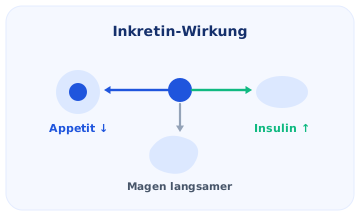
Cagrilintide is a synthetic analogue of the body's own hormone amylin, which is secreted together with insulin by the beta cells of the pancreas. As an amylin receptor agonist, it activates amylin receptors (including AMY1R and AMY3R) in brainstem regions involved in the control of appetite and satiety. Preclinical investigations attribute the weight-lowering effect to these central amylin receptors. Effects under discussion include an enhanced feeling of satiety, slowed gastric emptying and reduced food intake. In the CagriSema combination, cagrilintide is intended to complement the GLP-1 mechanism of semaglutide. This description reflects the state of research and is not a set of instructions for use.
Cagrilintide is a purely research or investigational agent. All available data come from controlled clinical trials or preclinical models under medical supervision. Outside such studies, there is no tested, safe form of use.
Research history
Cagrilintide (development name AM833 or NNC0174-0833) was developed by Novo Nordisk as a long-acting amylin analogue. After early clinical trials, the fixed combination with semaglutide (CagriSema) came particularly into focus: a phase 2 trial in type 2 diabetes published in The Lancet in 2023 showed greater weight loss for the combination than for the individual agents. An extensive phase 3 programme followed (REDEFINE in obesity/overweight, REIMAGINE in type 2 diabetes). In REDEFINE 1 (published in 2025 in the New England Journal of Medicine), cagrilintide monotherapy, semaglutide monotherapy and CagriSema were compared against placebo. For the CagriSema combination, Novo Nordisk submitted a marketing application (NDA) to the US FDA at the end of 2025; a decision was still pending as of this profile's knowledge cut-off. Cagrilintide as a standalone medicine is being further investigated in a dedicated phase 3 programme.
Positive aspects
What the research shows that is promising
Research areas
- Overweight and obesity (weight regulation) – monotherapy and combination
- Type 2 diabetes with overweight (CagriSema, REIMAGINE programme)
- Appetite and satiety control via central amylin receptors
- Combination effect with GLP-1 analogues (amylin-plus-GLP-1 approach)
- Accompanying cardiometabolic parameters (blood pressure, waist circumference, lipids, glucose metabolism) in trials
Documented effects (from the literature)
- In clinical trials, gastrointestinal complaints (e.g. nausea, vomiting, diarrhoea, constipation, abdominal pain) were the most common adverse effects; they were predominantly mild to moderate and mostly transient.
- The clinical data come from controlled trials in adults with overweight/obesity or type 2 diabetes and describe efficacy on body weight as well as the observed side-effect profile.
- Reported accompanying effects in combination trials concerned, among other things, changes in cardiometabolic parameters; their assessment is being carried out within the ongoing clinical investigation.
Risk analysis
What to view critically and honestly
Regulatory status by region
The European Medicines Agency (EMA) has approved neither cagrilintide as monotherapy nor the CagriSema combination. The agent holds the status of an investigational product.
Cagrilintide as monotherapy is being investigated in a dedicated phase 3 programme and is not approved. For the CagriSema combination, Novo Nordisk submitted a marketing application (NDA) to the FDA at the end of 2025; an approval was not in place as of this profile's knowledge cut-off.
In no region of the world is cagrilintide available as an approved medicine. Legal use takes place exclusively within the framework of authorised clinical trials.
Safety concerns & caution
- Gastrointestinal side effects are common and may limit tolerability.
- The data are not yet complete: long-term safety and rare risks are only incompletely known for an investigational agent.
- A large part of the published data concerns the CagriSema combination; the isolated long-term assessment of monotherapy is still maturing.
- Statements on efficacy and safety apply only under the controlled conditions of the trials with medical supervision.
Risks of gray-market purchase
- Cagrilintide offered on the grey market as a "research chemical" or "research vials" is not an approved medicine; its identity, purity, dosage and sterility cannot be verified.
- Promotional claims from such sources are to be regarded as unsubstantiated assertions and not as established facts.
- Without approval and medical supervision, any quality control, pharmacovigilance and legal safeguards are absent; health risks are incalculable.
- Contaminants, mislabelling or deviating substances cannot be ruled out in unregulated products.
Frequently asked questions
Is cagrilintide approved as a medicine?
No. Cagrilintide is an investigational agent and is not approved as a standalone medicine in any region. The CagriSema combination (cagrilintide plus semaglutide) was also not approved as of this profile's knowledge cut-off, although Novo Nordisk submitted a marketing application to the FDA at the end of 2025.
How does cagrilintide differ from GLP-1 agents such as semaglutide?
Cagrilintide is an amylin analogue and acts via amylin receptors, whereas semaglutide is a GLP-1 analogue. Both approaches influence appetite and satiety through different pathways. In the CagriSema combination, both mechanisms are brought together; in trials, the combination showed greater weight loss than the individual agents.
What did the REDEFINE 1 trial show for cagrilintide?
In the 68-week phase 3 trial REDEFINE 1 (published in 2025 in the New England Journal of Medicine), cagrilintide as monotherapy, the CagriSema combination and semaglutide monotherapy were compared against placebo. Cagrilintide alone produced around 11.8% weight reduction and the CagriSema combination about 20.4% – each compared with markedly lower values on placebo. These data apply exclusively under the controlled trial conditions.
Is the use of cagrilintide safe?
The available safety data come from clinical trials under medical supervision; gastrointestinal complaints occurred most frequently. Because it is an investigational agent, long-term safety and rare risks are not yet conclusively known. Safe use outside authorised trials is not established.
Sources
Primary and reference sources for your own reading.
- New England Journal of Medicine (2025)Coadministered Cagrilintide and Semaglutide in Adults with Overweight or Obesity (REDEFINE 1)
- The Lancet (2023), PubMed PMID 37364590Efficacy and safety of co-administered once-weekly cagrilintide 2·4 mg with once-weekly semaglutide 2·4 mg in type 2 diabetes: a phase 2 trial
- ClinicalTrials.gov, NCT05567796 (Sponsor: Novo Nordisk A/S, Phase 3)Efficacy and Safety of Cagrilintide s.c. 2.4 mg in Combination With Semaglutide s.c. 2.4 mg (REDEFINE 1)
- eBioMedicine (2025), PMC12270663Cagrilintide lowers bodyweight through brain amylin receptors 1 and 3
- New England Journal of Medicine (2025)Cagrilintide–Semaglutide in Adults with Overweight or Obesity and Type 2 Diabetes (REDEFINE 2)
Related substances
Mentioned in these research updates
Unfamiliar terms? Look them up in the glossary or read the fundamentals.
This profile is for information and education only. It is not medical advice and deliberately contains no dosing or usage details. Decisions about use belong in a doctor’s hands.