Beginner view — everything explained simply.
Machine-assisted translation — the German original version is authoritative.

Metabolism & Weight
Ecnoglutid
Ecnoglutide · XW003 · Xianyida (Handelsname Typ-2-Diabetes, China) · Xianweiying (Handelsname Gewichtsregulation, China) · XW004 (orale Form in Entwicklung)
Ecnoglutide (development code XW003) is a peptide GLP-1 receptor agonist designed as a product studied for once-weekly administration, developed by the Chinese company Sciwind Biosciences (Hangzhou). Its distinctive feature is so-called cAMP-biased signaling: based on the study data, the molecule preferentially activates the cAMP signaling pathway while triggering hardly any receptor internalization. In China, ecnoglutide received NMPA approval for blood glucose control in type 2 diabetes in early 2026 (trade name Xianyida, announced late January 2026) and in March 2026 for long-term weight management (trade name Xianweiying, announced 6 Mar 2026). Outside China - particularly in the EU and the USA - ecnoglutide is not approved and is considered experimental there. This profile is for information only and contains no instruction for use.
Regulatory status
Approved · prescription-only
As of October 2026: approved and prescription-only in China (NMPA) for type 2 diabetes (Xianyida) and weight management (Xianweiying); not approved in the EU and USA and still experimental there.
Drug class
Peptide GLP-1 receptor agonist with cAMP-biased signaling
Half-life (informative)
Ecnoglutide is pharmacokinetically designed as a once-weekly product; the attached fatty acid side chain extends the residence time in the body. No applicable values for dosage, amounts, or dosing intervals are deliberately stated here.
Studied in the literature
In the pivotal clinical studies (SLIMMER, EECOH-1, EECOH-2, Phase 2), ecnoglutide was studied subcutaneously (under the skin). An oral tablet form (XW004, later VRB-101) is being tested in separate development studies. This describes exclusively HOW the active substance was studied in research and does not constitute an instruction for use.
Mechanism of action
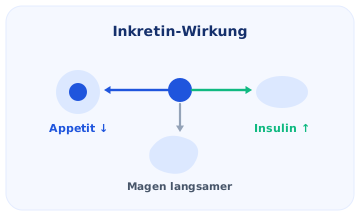
Ecnoglutide mimics - like other incretin mimetics - the body's own intestinal hormone GLP-1 (Glucagon-like Peptide-1): via the GLP-1 receptor, a glucose-dependent insulin secretion, a dampened glucagon release, a slowed gastric emptying, and a reduction in appetite are described. The conceptual distinctive feature is the 'biased' signaling: in the first description (Molecular Metabolism 2023), ecnoglutide is characterized as a cAMP-biased GLP-1 analogue that strongly triggers the intracellular cAMP signaling pathway while at the same time causing hardly any receptor internalization. The low receptor internalization is the measured value reported in the first description; the internalization and beta-arrestin pathway is not separately quantified in the source. This bias is discussed in the literature as a possible reason for a sustained effect and favorable metabolic effects. As documented molecular details, the following are described: a peptide with one amino acid substitution site (alanine to valine at position 8) and an attached fatty acid side chain (a C18 diacid via a linker) that extends the residence time in the body and is intended to allow once-weekly administration.
The published efficacy and tolerability data come predominantly from studies in Chinese adults with overweight/obesity or type 2 diabetes; several authors are employed by Sciwind (study sponsor and funder). The distinguishing feature compared with conventional GLP-1 agents is the cAMP-biased signaling - a principle described in studies but not yet conclusively classified in terms of its long-term clinical significance.
Research history
The compound originates from the Chinese company Sciwind Biosciences (Hangzhou) and was developed under the code XW003. The preclinical/pharmacological first description appeared in 2023 in Molecular Metabolism (cAMP-biased GLP-1 analogue). This was followed by a Phase 2 study in type 2 diabetes (145 adults, 20 weeks, HbA1c endpoint; Nature Communications, 27 Sep 2024). The Phase 3 program comprises the obesity study SLIMMER (randomized, double-blind, placebo-controlled, 36 centers in China, 664 participants, primary endpoints at week 40; principal investigator Linong Ji; registered as NCT05813795; published in The Lancet Diabetes & Endocrinology, 21 Jun 2025) as well as the diabetes program EECOH with EECOH-1 (monotherapy versus placebo, 32 centers, 24 weeks, 211 participants; Nature Communications, 7 Jan 2026) and EECOH-2 (versus dulaglutide on top of metformin, 52 hospitals, 52 weeks, non-inferiority, 623 randomized; The Lancet Diabetes & Endocrinology, October 2025). The NMPA approval for blood glucose control in type 2 diabetes was announced in late January 2026 (trade name Xianyida), and the approval for long-term weight management on 6 Mar 2026 (trade name Xianweiying). Pfizer licensed the exclusive commercialization rights for weight management in mainland China from Sciwind in February 2026 (up to USD 495 million in upfront and milestone payments; Sciwind remains the marketing authorization holder and continues research/manufacturing). In parallel, an oral tablet form (code XW004) is being developed - a Phase 1 study (Australia, NCT05184322) reported interim data in 2024; the oral development was later continued by the company Verdiva Bio (code VRB-101) in a Phase 2b study (EVOLVE-2, NCT07281937).
Positive aspects
What the research shows that is promising
Research areas
- Blood glucose control in type 2 diabetes (Phase 3 program EECOH: EECOH-1 monotherapy versus placebo, EECOH-2 compared with dulaglutide on top of metformin; HbA1c reduction in EECOH-1 by up to around 2.4 percentage points after 24 weeks versus around 0.9 with placebo)
- Long-term weight management in overweight/obesity (Phase 3 study SLIMMER; dose-dependently described, increasing weight loss of up to around 13% after 40 weeks, >=5% weight loss in 77-87% of those treated versus 16% with placebo; week-48 values reported by the manufacturer: on average around 15.4%, >=5% in around 92.8%, >=10% in around 79.6%, >=15% in around 63.5% - manufacturer's information)
- Liver fat and cardiometabolic parameters (waist circumference, blood lipids, blood pressure, uric acid, liver enzymes; described as secondary endpoints in SLIMMER)
- Further testing according to a review article (Drugs 2026, 'Ecnoglutide: First Approvals') including in adolescents with obesity, in obesity with obstructive sleep apnea, and in obesity with knee osteoarthritis
- Oral tablet form (development code XW004; later developed further as VRB-101 at Verdiva Bio, Phase 2b study EVOLVE-2 NCT07281937, topline planned by the company for the end of 2026) in clinical development, separate from the approved injectable form
Documented effects (from the literature)
- The most common adverse effects reported in studies were mild to moderate gastrointestinal complaints (including nausea, vomiting, diarrhea, decreased appetite); in the obesity study SLIMMER (The Lancet Diabetes & Endocrinology 2025), adverse events occurred in around 93% of ecnoglutide participants versus 84% with placebo
- In the diabetes comparison study EECOH-2 (versus dulaglutide, The Lancet Diabetes & Endocrinology 2025), only a few participants discontinued treatment due to adverse effects (around 3-4% with ecnoglutide versus around 3% with dulaglutide); both groups were described as well tolerated
- The gastrointestinal complaints occurred, according to the Chinese registration studies, predominantly in the initiation/titration phase and decreased over the course of treatment
Risk analysis
What to view critically and honestly
Regulatory status by region
Approval for blood glucose control in type 2 diabetes (announced late January 2026, trade name Xianyida) and for long-term weight management in obesity or overweight with at least one weight-related comorbidity (announced 6 Mar 2026, trade name Xianweiying). According to the manufacturer, the first approved cAMP-biased GLP-1 receptor agonist. Pfizer licensed the exclusive commercialization rights for weight management in mainland China from Sciwind in February 2026; Sciwind remains the marketing authorization holder.
No approval by the EMA known; no submission traceable either. In Europe, ecnoglutide is considered experimental; use outside clinical studies is not intended.
No FDA approval known; no submission traceable either. In the USA, ecnoglutide is considered experimental.
Safety concerns & caution
- Class-typical expected for GLP-1 receptor agonists (not specifically reported as an ecnoglutide observation): thyroid C-cell tumors described in animal studies, as well as precautionary notes generally cited for the drug class regarding pancreatitis and gallbladder complaints
- Long-term safety data beyond the study duration are limited; longer-term tolerability has not yet been conclusively characterized
- The data basis comes predominantly from Chinese study populations; transferability to other population groups is not automatically given
- The long-term clinical significance of cAMP-biased signaling compared with conventional GLP-1 agents has not yet been conclusively demonstrated
- Outside China there is no regulatory-reviewed approval; medical use in the EU/USA is not intended
Risks of gray-market purchase
- Products offered as a 'research chemical' are often advertised with unsubstantiated comparative claims (e.g., 'stronger than semaglutide') - such statements are advertising promises, not established facts
- With non-approved sources, the identity, purity, content, and sterility of the product cannot be verified; impurities or mislabeling are possible
- The Chinese approval does not transfer to grey-market goods: approval in one country does not make a product sold unofficially elsewhere a reviewed medicine
- Without medical supervision, adverse effects, interactions, and contraindications cannot be adequately assessed
Frequently asked questions
Is ecnoglutide approved anywhere?
Yes, but only in China. The Chinese regulator NMPA approved ecnoglutide in early 2026 for blood glucose control in type 2 diabetes (announced late January 2026, trade name Xianyida) and in March 2026 for long-term weight management (announced 6 Mar 2026, trade name Xianweiying). In the EU and the USA there is no approval; there the active substance is considered experimental.
What does 'cAMP-biased' signaling mean?
GLP-1 receptors can, after their activation, trigger several cellular signaling pathways. Ecnoglutide is designed so that it preferentially triggers the cAMP signaling pathway while hardly 'pulling in' the receptor (low receptor internalization). This bias is discussed in research as a possible reason for a sustained effect; however, its long-term clinical significance has not yet been conclusively demonstrated.
Who develops ecnoglutide, and what does Pfizer have to do with it?
The active substance is developed by the Chinese company Sciwind Biosciences (code XW003). In February 2026, Pfizer licensed the exclusive commercialization rights for weight management in mainland China from Sciwind; Sciwind remains the marketing authorization holder. This concerns commercialization in China; an approval in the EU or the USA is not associated with it.
What results did the studies show?
In the obesity study SLIMMER, an increasing weight loss of up to around 13% was described after 40 weeks; 77-87% of those treated lost at least 5% of body weight versus 16% with placebo. In the type 2 diabetes studies (EECOH-1, EECOH-2), ecnoglutide markedly lowered the long-term blood glucose value HbA1c; in the direct comparison it was non-inferior to the established agent dulaglutide. This profile deliberately gives no information on amounts or usage schedules.
What adverse effects were observed?
The most common - as is usual with GLP-1 agents - were mild to moderate gastrointestinal complaints such as nausea, vomiting, diarrhea, and decreased appetite, especially at the start. Treatment discontinuations due to adverse effects were rare in the studies. Long-term data beyond the study duration are limited.
Is there also a tablet form of ecnoglutide?
An oral tablet form (development code XW004, later developed further as VRB-101 at Verdiva Bio) is in clinical development and is not approved. The form approved in China is the injectable variant. The oral form is a separate development project with its own, still ongoing data status.
Sources
Primary and reference sources for your own reading.
- Molecular Metabolism (PubMed)Discovery of ecnoglutide - A novel, long-acting, cAMP-biased glucagon-like peptide-1 (GLP-1) analog
- The Lancet Diabetes & Endocrinology (PubMed)Efficacy and safety of a biased GLP-1 receptor agonist ecnoglutide in adults with overweight or obesity: a multicentre, randomised, double-blind, placebo-controlled, phase 3 trial
- ClinicalTrials.govSLIMMER - Phase-3-Studie von XW003 (Ecnoglutid) bei Uebergewicht oder Adipositas (Studienregister)
- Nature Communications (PubMed)Efficacy and safety of cAMP signalling-biased GLP-1 analogue ecnoglutide monotherapy versus placebo in patients with type 2 diabetes (EECOH-1): a multi-centre, randomised, double-blind, placebo-controlled, phase 3 trial
- The Lancet Diabetes & Endocrinology (PubMed)Efficacy and safety of cAMP-biased GLP-1 receptor agonist ecnoglutide versus dulaglutide in patients with type 2 diabetes on metformin monotherapy (EECOH-2): a 52-week, multicentre, open-label, non-inferiority, randomised, phase 3 trial
- Nature Communications (PubMed)Efficacy and safety of GLP-1 analog ecnoglutide in adults with type 2 diabetes: a randomized, double-blind, placebo-controlled phase 2 trial
- Drugs (PubMed)Ecnoglutide: First Approvals
- Sciwind Biosciences (BioSpace, Pressemitteilung)Sciwind Biosciences Announces Ecnoglutide Injection Approved by China's NMPA for Chronic Weight Management
- BioPharm InternationalChina approval of ecnoglutide expands competition in the GLP-1 obesity market
- Fierce PharmaPfizer breaks into obesity market in China with approval for Sciwind-partnered GLP-1
Related substances
Mentioned in these research updates
Unfamiliar terms? Look them up in the glossary or read the fundamentals.
This profile is for information and education only. It is not medical advice and deliberately contains no dosing or usage details. Decisions about use belong in a doctor’s hands.