

Beginner view — everything explained simply.
Machine-assisted translation — the German original version is authoritative.

Metabolism & Weight
Eloralintid
Eloralintide · LY3841136 · Bestandteil von EloraTZP (Eloralintid + Tirzepatid)
Eloralintide (development code LY3841136) is an experimental, selective amylin receptor agonist that the US company Eli Lilly is studying for weight management. According to the manufacturer's data, in cell assays it preferentially activates the amylin-1 receptor and is described as AMY1R-selective - in contrast to non-selective amylin analogues such as cagrilintide or petrelintide. In a 48-week Phase 2 study in 263 adults without type 2 diabetes (published in The Lancet in 2025), eloralintide led, dose-dependently, to average weight reductions of about 9% to 20% versus around 0.4% with placebo. Both the monotherapy (Phase 3 program ENLIGHTEN) and the combination with tirzepatide under the name EloraTZP (Phase 2b, EASD 2026) are being studied. As of October 2026, eloralintide is not approved as a medicine in any region; this profile is for information only and is not a usage, dosing, or procurement guide.
Regulatory status
In clinical trials only · not approved
As of October 2026, eloralintide is in clinical testing (Phase 3) and is not approved as a medicine in any region.
Drug class
Selective amylin receptor agonist (according to the manufacturer's data, acting preferentially at the amylin-1 receptor/AMY1R); an experimental peptide agent for weight management, studied as a monotherapy and as a combination partner of tirzepatide (EloraTZP).
Half-life (informative)
Eloralintide is designed as a product to be studied once weekly; the manufacturer describes the preclinical and Phase 1 pharmacokinetics as compatible with weekly administration. Specific pharmacokinetic values are deliberately not reproduced here in applicable form - they come from studies and are not a dosing statement.
Studied in the literature
In all studies published so far, eloralintide was studied exclusively as a subcutaneous injection - as a monotherapy or together with tirzepatide (EloraTZP, as separate injections). This describes exclusively HOW the active substance was studied in trials and is expressly not an instruction for use and no call to self-administration.
Mechanism of action
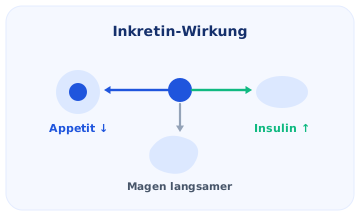
Eloralintide is a synthetic amylin receptor agonist and thereby mimics the action of the body's own hormone amylin, which is secreted together with insulin from the beta cells of the pancreas. In cell assays, according to the manufacturer, it preferentially activates the amylin-1 receptor (AMY1R) and much more weakly the calcitonin receptor and the amylin-3 receptor; it is therefore characterized as a selective (AMY1R-preferring) agonist and distinguished from non-selective amylin analogues (Molecular Metabolism 2025, manufacturer's data). Via these receptors located centrally in the brainstem, satiety is intended - conceptually - to be enhanced and food intake reduced. In preclinical rodent models, eloralintide triggered, according to the manufacturer, less conditioned taste aversion than the non-selective cagrilintide, which is interpreted as a possible indication of better gastrointestinal tolerability. This information reflects the published state of research and is not an instruction for use.
Eloralintide is a purely research/investigational substance. All available data come from controlled clinical studies or preclinical models under medical supervision and in part only as a congress presentation or manufacturer's statement. Outside approved clinical studies, there is no reviewed, safe form of use.
Research history
Eloralintide (development code LY3841136) is being developed by Eli Lilly and Company. Preclinical characterization and a first clinical proof-of-concept in healthy volunteers were published in 2025/2026 (Briere et al., Molecular Metabolism, October 2025; Phase 1 data additionally in Diabetes, Obesity & Metabolism 2026). The Phase 2 monotherapy study (ClinicalTrials.gov NCT06230523) started on 5 February 2024, was completed on 14 August 2025, presented at ObesityWeek 2025, and published in The Lancet on 6 November 2025 (Billings et al.). In parallel, a Phase 2b study ran on the combination with tirzepatide (EloraTZP, NCT06603571, start September 2024, completed September 2026) in overweight/obesity and type 2 diabetes, the results of which were presented at the EASD annual meeting in 2026. The Phase 3 program of the monotherapy (ENLIGHTEN) has started: ENLIGHTEN-2 (with type 2 diabetes, NCT07282600) started on 15 December 2025, ENLIGHTEN-1 (without type 2 diabetes, NCT07321886) on 6 February 2026; both are recruiting (as of October 2026). For an EloraTZP co-formulation, Eli Lilly announced the start of a Phase 3 program by the end of 2026 - this statement is a planning statement by the manufacturer.
Positive aspects
What the research shows that is promising
Research areas
- Overweight and obesity without type 2 diabetes (monotherapy, Phase 3 program ENLIGHTEN-1)
- Overweight/obesity with type 2 diabetes (monotherapy, ENLIGHTEN-2; combination EloraTZP)
- Combination with the GIP/GLP-1 receptor agonist tirzepatide (EloraTZP)
- Selective activation of the amylin-1 receptor for appetite and satiety control
- Gastrointestinal tolerability compared with non-selective amylin analogues (preclinical)
- Accompanying cardiometabolic parameters (including HbA1c, waist circumference, blood pressure, lipids) in studies
Documented effects (from the literature)
- Phase 2 monotherapy (Billings et al., The Lancet 2025; NCT06230523, 263 adults, 48 weeks): the most common adverse effects were nausea and fatigue, predominantly mild to moderate and dose-dependent; these were mainly gastrointestinal complaints.
- Phase 1 proof-of-concept in healthy volunteers (Molecular Metabolism 2025 / Diabetes, Obesity & Metabolism 2026): with single doses, predominantly mild events occurred, gastrointestinal events were rare.
- Phase 2b combination EloraTZP (EASD 2026, NCT06603571, 367 adults with type 2 diabetes - preliminary congress/manufacturer data, not yet fully peer-reviewed): gastrointestinal events occurred mainly during dose escalation and more frequently in the combination arms; study discontinuations due to adverse effects were between 10.8% and 27.0% in the combination arms versus 2.9% with tirzepatide alone and 16.7% with placebo.
Risk analysis
What to view critically and honestly
Regulatory status by region
The European Medicines Agency (EMA) has approved eloralintide neither as a monotherapy nor as a combination (EloraTZP); there is also no CHMP opinion. In the EU study register CTIS, the investigational drug is listed as 'Not Authorised'. The active substance has the status of an investigational drug; this also applies to Germany.
The US regulator FDA has not approved eloralintide; a marketing application has not been publicly announced. The Phase 3 program ENLIGHTEN (ENLIGHTEN-1 without, ENLIGHTEN-2 with type 2 diabetes) is recruiting as of October 2026; a Phase 3 program for the tirzepatide combination EloraTZP has been announced by the manufacturer by the end of 2026.
The Chinese drug regulator (NMPA) has not approved eloralintide. The Chinese Center for Drug Evaluation (CDE) has merely authorized the conduct of global Phase 3 studies in China - this is a study authorization, not a market approval.
In no region of the world is eloralintide available as an approved medicine. Legal use occurs exclusively within the framework of approved clinical studies.
Safety concerns & caution
- Gastrointestinal adverse effects are class-typically to be expected with amylin and incretin agents and can limit tolerability; higher discontinuation rates were reported in the tirzepatide combination.
- The data situation is preliminary: the combination results (EloraTZP) so far exist only as a congress presentation and manufacturer topline; a full peer-reviewed publication is lacking.
- Long-term safety and rare risks are only incompletely known for an investigational substance; the confirmatory Phase 3 results (ENLIGHTEN) are still pending.
- Phase 2 findings are not always fully confirmed in larger, longer studies; the final classification of efficacy and the benefit-risk ratio remains reserved for the ongoing Phase 3 studies.
- All efficacy and safety statements apply exclusively under the controlled conditions of clinical studies with medical monitoring.
Risks of gray-market purchase
- Eloralintide offered on the grey market as a 'research chemical' or 'research vial' is not an approved medicine; identity, purity, composition, and sterility cannot be verified.
- Advertising statements from such sources are unsubstantiated claims and not established facts.
- Without approval and medical supervision, any quality control, pharmacovigilance, and legal safeguards are absent; health risks are incalculable.
- Impurities, mislabeling, or deviating substances cannot be ruled out in unregulated products.
Frequently asked questions
Is eloralintide approved as a medicine?
No. Eloralintide (LY3841136) is an investigational substance and, as of October 2026, not approved in any region. The monotherapy is in the Phase 3 program ENLIGHTEN, which is still recruiting; a safe use outside approved studies is not demonstrated.
How does eloralintide differ from other amylin agents such as cagrilintide or petrelintide?
Eloralintide is described by the manufacturer as a selective amylin receptor agonist that, in cell assays, preferentially activates the amylin-1 receptor (AMY1R). Non-selective amylin analogues such as cagrilintide or petrelintide address the amylin and the calcitonin receptor more broadly. In preclinical models, a better gastrointestinal tolerability was suggested for eloralintide; whether this difference is clinically relevant in humans is being examined by ongoing studies.
What did the Phase 2 study of the monotherapy show?
In the 48-week, placebo-controlled Phase 2 study in 263 adults without type 2 diabetes (published in 2025 in The Lancet, NCT06230523), all eloralintide groups met the primary endpoint. The average weight reduction increased dose-dependently and ranged across the study arms from about 9% to 20%, compared with around 0.4% with placebo. These values apply exclusively under controlled study conditions.
What is EloraTZP?
EloraTZP is the experimental combination of eloralintide and the GIP/GLP-1 receptor agonist tirzepatide. In a Phase 2b study in 367 adults with overweight/obesity and type 2 diabetes (EASD 2026, NCT06603571, 48 weeks), the combination achieved, according to preliminary congress data, up to 23.3% average weight reduction versus 14.8% with tirzepatide alone and 8.2-12.3% with eloralintide alone. This information is preliminary manufacturer/congress data; an EloraTZP co-formulation is, according to Eli Lilly, to be studied in Phase 3 from the end of 2026.
Is the use of eloralintide safe?
The available safety data come from clinical studies under medical supervision; the most common were gastrointestinal complaints and fatigue, with higher discontinuation rates in the tirzepatide combination. Because this is an investigational substance, long-term safety and rare risks are not yet conclusively known. A safe use outside approved studies is not demonstrated.
Who is eloralintide being studied for?
Eloralintide is being studied for weight management in adults with obesity or overweight - in the Phase 3 program ENLIGHTEN both without (ENLIGHTEN-1) and with type 2 diabetes (ENLIGHTEN-2). This describes the study populations examined and is not a recommendation for use.
Sources
Primary and reference sources for your own reading.
- The Lancet (2025), 406(10520):2631-2643, Billings LK et al., PMID 41207310Eloralintide, a selective amylin receptor agonist for the treatment of obesity: a 48-week phase 2, multicentre, double-blind, randomised, placebo-controlled trial
- Molecular Metabolism (2025), 102:102271, Briere DA et al., PMID 41109426Eloralintide (LY3841136), a novel amylin receptor agonist for the treatment of obesity: From discovery to clinical proof of concept
- Diabetes, Obesity & Metabolism (2026), Bhattachar S et al., PMID 41559929Eloralintide, a selective, long-acting amylin receptor agonist for treatment of obesity: Phase 1 proof of concept
- ClinicalTrials.gov, NCT06230523 (Sponsor: Eli Lilly and Company)A Study of LY3841136 (Eloralintide) Compared With Placebo in Adult Participants With Obesity or Overweight (Phase 2, 48 Wochen)
- ClinicalTrials.gov, NCT06603571 (Sponsor: Eli Lilly and Company)A Study of Eloralintide and Tirzepatide, Alone or in Combination, in Obesity or Overweight and Type 2 Diabetes (EloraTZP, Phase 2b)
- ClinicalTrials.gov, NCT07321886 (Sponsor: Eli Lilly and Company)A Study of Eloralintide (LY3841136) in Participants With Obesity, or Overweight Without Type 2 Diabetes (ENLIGHTEN-1, Phase 3)
- ClinicalTrials.gov, NCT07282600 (Sponsor: Eli Lilly and Company)A Study of Eloralintide in Participants With Obesity or Overweight, and Type 2 Diabetes (ENLIGHTEN-2, Phase 3)
- HCPLive (6. November 2025) - Berichterstattung zur Phase-2-PublikationInvestigative Amylin Agonist Eloralintide Proves Superiority to Placebo in Weight Management
- HCPLive (30. September 2026) - Kongressberichterstattung EASD 2026EASD 2026: EloraTZP Bests Tirzepatide on Weight Loss, A1C in Type 2 Diabetes
Related substances
Mentioned in these research updates
Unfamiliar terms? Look them up in the glossary or read the fundamentals.
This profile is for information and education only. It is not medical advice and deliberately contains no dosing or usage details. Decisions about use belong in a doctor’s hands.