
Beginner view — everything explained simply.
Machine-assisted translation — the German original version is authoritative.

Hormonal System & Reproduction
Navepegritid
Yuviwel · TransCon CNP · Navepegritide
Navepegritide (development name TransCon CNP, trade name Yuviwel) is a once-weekly subcutaneously administered prodrug of C-type natriuretic peptide (CNP) developed by Ascendis Pharma. It is used to increase linear growth in children aged 2 years and older with achondroplasia - the most common form of short stature - as long as their growth plates (epiphyses) are still open. The US regulator FDA granted accelerated approval on 27 February 2026; according to Ascendis, the product has been commercially available in the USA since early April 2026. In the EU, the CHMP issued a positive opinion on 15 October 2026; final approval by the European Commission was still pending as of October 2026. The basis includes, among others, the Phase 2 dose-finding study ACcomplisH and the pivotal study ApproaCH, in which navepegritide significantly increased the annualized growth velocity compared with placebo. Important for context: CNP is a locally (paracrine) acting peptide hormone of the growth plates and is NOT a growth hormone - the active substance acts exclusively via the cartilage cells of open epiphyses and is not a "growth" or muscle-building peptide for adults.
Regulatory status
Approved · prescription-only
As of October 2026: granted accelerated approval by the FDA in the USA (27 Feb 2026) and on the market since early April 2026; in the EU, positive CHMP opinion (15 Oct 2026), final approval by the European Commission still pending.
Drug class
Long-acting prodrug of C-type natriuretic peptide (CNP) - extended via Ascendis's TransCon carrier technology into a once-weekly subcutaneously administered depot; a prescription finished medicinal product for achondroplasia, not a growth hormone.
Half-life (informative)
Designed as a once-weekly product: the TransCon principle releases the active CNP in a delayed and steady manner after injection, so that a sustained drug exposure is maintained across the weekly interval - in contrast to the very short-lived endogenous natriuretic peptides. This educational profile deliberately states no applicable pharmacokinetic values.
Studied in the literature
In the ACcomplisH and ApproaCH studies, investigated exclusively as a once-weekly subcutaneous injection in children; this describes the study design and is expressly not an instruction for use. Under the terms of the approval, prescribing and monitoring belong in the hands of physicians experienced in treating achondroplasia.
Mechanism of action
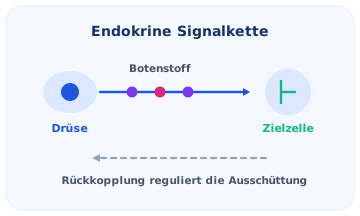
Achondroplasia is caused by constitutive activation of fibroblast growth factor receptor 3 (FGFR3), which slows the linear growth of bones at the growth plates. Navepegritide is a prodrug: via the TransCon carrier technology (the same basic principle as the parathyroid hormone prodrug palopegteriparatide), the active C-type natriuretic peptide (CNP) is temporarily bound to an inert carrier and is slowly and steadily released after injection, so that a sustained CNP exposure is maintained across the weekly interval. The released CNP binds to natriuretic peptide receptor B (NPR-B) on the cartilage cells (chondrocytes) of the growth plates and there increases cGMP and protein kinase G signaling, which counteracts the FGFR3 signaling that is overactive in achondroplasia and inhibits the downstream MAPK signaling pathway (according to the FDA prescribing information). This promotes the division and maturation of chondrocytes and partly compensates for the impaired linear growth. Conceptually decisive: the active substance does NOT act on the growth hormone/IGF-1 axis, but rather acts in a paracrine manner directly on the cartilage - and only where the epiphyses are still open.
The diagnosis of achondroplasia must be confirmed, and patients must have open epiphyses. The US approval was granted on an accelerated basis on the surrogate endpoint "annualized growth velocity"; according to the FDA label, continued approval depends on confirmation of clinical benefit in confirmatory studies. This profile states no doses, concentrations, or preparation/injection steps.
Research history
Navepegritide emerged from Ascendis Pharma's TransCon platform, which converts short-acting active substances into a depot form through reversible binding to an inert carrier. Development included the Phase 2 dose-finding study ACcomplisH (NCT04085523, start 24 June 2020, completed) in 57 children with achondroplasia aged 2 to 10 years; the primary endpoint was annualized growth velocity after 52 weeks. This was followed by the pivotal study ApproaCH (NCT05598320, start 2023) - a multicenter, double-blind, randomized, placebo-controlled study in 84 children (2 to 11 years) at 10 centers in seven countries, listed in the registry as Phase 2/3 and published as a Phase 2b study (JAMA Pediatrics 2026;180(1):18-25, online ahead of print November 2025, print edition January 2026; first author R. Savarirayan; study results posted to the registry on 14 July 2026). The FDA granted accelerated approval for Yuviwel on 27 February 2026; according to an Ascendis statement of 6 April 2026, the product has been commercially available in the USA since then and carries FDA orphan drug exclusivity. In Europe, the CHMP issued a positive marketing authorization recommendation on 15 October 2026; the decision by the European Commission was still pending as of 24 October 2026 (expected by the manufacturer for the fourth quarter of 2026, with a planned first EU launch in Germany in the first quarter of 2027 - manufacturer's information).
Positive aspects
What the research shows that is promising
Research areas
- Increasing linear growth in children aged 2 years and older with achondroplasia and open epiphyses (approved indication)
- Body proportions and leg axes (including tibia-femur angle, mechanical axis deviation, fibula-tibia length ratio) - secondary endpoints in ApproaCH
- Health-related quality of life and physical function (ACEM instrument)
- Long-term efficacy and safety across the open-label extension phase
- Confirmation of a clinical benefit beyond growth alone (still pending; a condition of the accelerated US approval)
Documented effects (from the literature)
- ApproaCH (JAMA Pediatrics 2026): the annualized growth velocity after 52 weeks was around 5.89 cm/year with navepegritide versus around 4.41 cm/year with placebo - a statistically significant difference (LSM difference 1.49 cm/year; 95% CI 1.05-1.93; p<0.001)
- ApproaCH: significant improvements over placebo in secondary endpoints - leg axis (tibia-femur angle), mechanical axis deviation and fibula-tibia length ratio, as well as physical function (ACEM) in children under 5 years
- ApproaCH safety (ClinicalTrials.gov results module, week 52): non-serious adverse events in 91.2% (navepegritide) vs. 92.6% (placebo); serious events in 5.3% vs. 11.1%, none of which were treatment-related according to JAMA Pediatrics; no deaths, no symptomatic hypotension and no fractures, injection-site reactions minor
- FDA prescribing information (label): the most common adverse reactions (>=5%) are vomiting, injection-site reactions, pain in the extremities and nausea
- EMA/CHMP (October 2026): the most common adverse reactions cited - injection-site reactions and hypertrichosis (increased hair growth, including at the injection site)
Risk analysis
What to view critically and honestly
Regulatory status by region
Accelerated Approval dated 27 February 2026. Indication according to the FDA prescribing information: to increase linear growth in pediatric patients aged 2 years and older with achondroplasia and open epiphyses. The accelerated approval is based on the surrogate endpoint of annualized growth velocity; continued approval depends on confirmatory studies according to the label. According to an Ascendis statement of 6 April 2026, commercially available, with orphan drug exclusivity. Most common adverse reactions (>=5%) according to the label: vomiting, injection-site reaction, pain in the extremities, nausea.
Positive CHMP opinion on 15 October 2026 (applicant Ascendis Pharma Growth Disorders A/S); recommended indication: treatment of achondroplasia in children aged 2 years and older whose epiphyses are not yet closed. The decision of the European Commission had not yet been made as of 24 Oct 2026 (expected by the manufacturer for Q4 2026). Most common adverse reactions according to the EMA: injection-site reactions and hypertrichosis. Orphan status is being reviewed by the EMA.
Not yet approved/available in Germany. The manufacturer has announced Germany as the planned first EU launch following a possible EU approval, for the first quarter of 2027 - a planning statement, not a guaranteed date.
Safety concerns & caution
- A drop in blood pressure/hypotension is considered a class-typical expected effect for CNP-based agents (CNP has a vasodilatory effect); no symptomatic hypotension was observed in ApproaCH, yet medical monitoring remains warranted
- The US approval is accelerated and based on the surrogate endpoint of growth velocity - a long-term clinical benefit (e.g., for complications or quality of life over years) has not yet been confirmed
- Acts only where the growth plates (epiphyses) are still open; after they close, no effect on linear growth is to be expected. Studied and approved exclusively for children
- Long-term safety data are limited; the diagnosis must be confirmed, and both prescribing and management belong in specialized centers
Risks of gray-market purchase
- Not a "growth" or muscle-building peptide for adults: because CNP acts via the growth plates, no linear growth is possible in adults with closed epiphyses - misuse as a performance or bodybuilding agent is biologically nonsensical and dangerous
- This is a prescription finished medicinal product for a rare disease in children; obtaining it via grey markets or as a "research peptide" bypasses the mandatory specialist management and (among other reasons, because of the possible blood-pressure effect) monitoring
- Counterfeiting and quality risk: imitated or repackaged goods offer no guarantee of purity, sterility or correct composition - especially critical when used in children
- Risk of confusion with growth hormone or with the CNP analogue vosoritide (Voxzogo) - these are different active substances with different usage and safety profiles
Frequently asked questions
Is navepegritide a growth hormone?
No. Navepegritide is a prodrug of C-type natriuretic peptide (CNP), a locally (paracrine) acting peptide hormone of the growth plates. It does not act on the growth hormone/IGF-1 axis, but binds to the NPR-B receptor on the cartilage cells of the growth plates and there counteracts the FGFR3 signaling pathway that is overactive in achondroplasia.
What is it used for?
For achondroplasia, the most common form of short stature. It is intended to increase linear growth in children aged 2 years and older, as long as their growth plates (epiphyses) are still open. Treatment is managed by specialized physicians.
Is it approved?
In the USA, yes: the FDA granted accelerated approval on 27 February 2026 (trade name Yuviwel), and the product has been on the market there since early April 2026. In the EU, the CHMP issued a positive recommendation on 15 October 2026; final approval by the European Commission was still pending as of October 2026. The basis is the ACcomplisH (Phase 2) and ApproaCH studies.
What does "accelerated approval" mean?
The US approval relies on a surrogate endpoint - the measured annual growth velocity - rather than on an already proven long-term benefit. According to the FDA, continued approval depends on confirmatory studies demonstrating the clinical benefit.
How does it differ from vosoritide (Voxzogo)?
Vosoritide (Voxzogo, BioMarin) was the first approved CNP-based agent for achondroplasia and is given as a daily injection. Navepegritide is a CNP prodrug designed for once-weekly administration. The two substances are different and have their own usage and safety profiles.
Can an adult use it to grow taller?
No. The active substance can only act where the growth plates are still open. In adults the epiphyses are closed, so linear growth is no longer possible. Use outside the pediatric indication is pointless and comes with avoidable risks.
Sources
Primary and reference sources for your own reading.
- U.S. National Library of Medicine (DailyMed) / FDAYUVIWEL (navepegritide) – FDA-Fachinformation / Label (DailyMed)
- JAMA Pediatrics 2026;180(1):18-25 (PMID 41247754)Once-Weekly Navepegritide in Children With Achondroplasia: The APPROACH Randomized Clinical Trial
- ClinicalTrials.gov (NCT05598320)ApproaCH: Trial of TransCon CNP vs. Placebo in Children With Achondroplasia (Studienregister inkl. Ergebnisse)
- ClinicalTrials.gov (NCT04085523)ACcomplisH: Phase-2-Studie zu TransCon CNP bei Kindern mit Achondroplasie (Studienregister)
- Europäische Arzneimittel-Agentur (EMA)Yuviwel (navepegritide) – CHMP-Stellungnahme / Arzneimittel-Übersicht
- Ascendis Pharma (Herstellermitteilung, via dpexnetwork)Ascendis Receives Orphan Drug Exclusivity and Makes YUVIWEL (navepegritide) Commercially Available in the United States
- Pharmacy TimesFDA Approves Navepegritide for Children With Achondroplasia
Related substances
Mentioned in these research updates
Unfamiliar terms? Look them up in the glossary or read the fundamentals.
This profile is for information and education only. It is not medical advice and deliberately contains no dosing or usage details. Decisions about use belong in a doctor’s hands.