Beginner view — everything explained simply.
Machine-assisted translation — the German original version is authoritative.

Metabolism & Weight
UBT251
UBT-251 · UBT 251 · UBT251 Injection · NN9559 (Novo-Nordisk-Projektcode in Studienregistern)
UBT251 is a long-acting, chemically synthesized peptide that simultaneously activates three hormone receptors: GLP-1, GIP and glucagon ("triple-G"). It was developed by United Biotechnology (Hengqin), a subsidiary of the Chinese The United Laboratories International Holdings (TUL); since March 2025, Novo Nordisk has held the rights outside mainland China, Hong Kong, Macau and Taiwan. In a Chinese Phase 2 study of 205 adults with overweight or obesity, body weight fell after 24 weeks by 13.6 to 19.7% depending on the study arm (placebo: 2.0%); the results have been published in Cell Metabolism since October 2026. In China, Phase 3 studies in obesity and type 2 diabetes have been running since September 2026, and Novo Nordisk is testing the active substance internationally in Phase 1b/2 and Phase 2 studies. UBT251 is a pure investigational drug: approved in no region, with so far only short study data (12 to 24 weeks) and exclusively from Chinese study populations.
Regulatory status
In clinical trials only · not approved
An investigational drug: in China in Phase 3 since September 2026 (obesity, type 2 diabetes), internationally via Novo Nordisk in Phase 1b/2 and Phase 2 studies; approved in no region (as of October 2026).
Drug class
GLP-1/GIP/glucagon receptor triple agonist ("triple-G agonist"); a long-acting, chemically synthesized peptide (investigational substance)
Half-life (informative)
Designed as a long-acting peptide and studied in all studies to date as a once-weekly product. The Phase 1 study describes approximately linear pharmacokinetics in the range studied; PeptidLotse deliberately does not state specific values.
Studied in the literature
Studied in all human studies to date as a subcutaneous injection once per week under medical study supervision. This describes exclusively the study design and is expressly not an instruction for use.
Mechanism of action
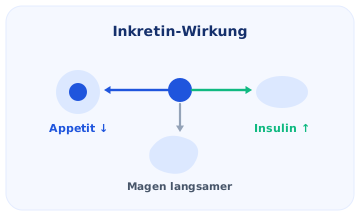
UBT251 simultaneously mimics three of the body's own intestinal and pancreatic hormones. Via the GLP-1 receptor it promotes - like semaglutide - the feeling of satiety, slows gastric emptying, and increases insulin secretion only when blood sugar is elevated. The GIP receptor (also addressed, as with tirzepatide) enhances blood-glucose-dependent insulin release and, according to current understanding, influences adipose tissue and appetite regulation. The third component, the glucagon receptor, is what is special about the "triple-G" class: glucagon can increase energy expenditure and stimulate fat breakdown in the liver; its blood-sugar-raising effect is intended to be offset by the GLP-1 and GIP action. The same mechanism is pursued by Eli Lilly's retatrutide. How strongly UBT251 activates the three individual receptors relative to one another, and exactly how the molecule is constructed, is not described in the publicly available summaries. The explanation above is therefore conceptual and applies to the drug class; what specific advantages the glucagon component brings in UBT251 is not yet demonstrated by long-term data.
According to the manufacturer, UBT251 is chemically synthesized (not produced biotechnologically). The amino acid sequence and the type of action-extension are not disclosed in the accessible sources. In the Phase 2 studies, several dose arms, in part with stepwise escalation, were compared against placebo or semaglutide. Amounts, levels, and schedules are deliberately not stated here, because PeptidLotse is an educational page and not a usage guide. In 2026/27, dedicated interaction studies are running (China: NCT07785934; Novo Nordisk: NCT07710729, NCT07710768), among other things on oral contraceptives, on gastric emptying, and on frequently co-administered medications.
Research history
UBT251 was developed by United Biotechnology (Hengqin) in Zhuhai, a wholly owned subsidiary of the Hong Kong-listed The United Laboratories International Holdings (TUL, stock code 3933). According to TUL, the company was the first in China and the second worldwide to bring a chemically synthesized, long-acting GLP-1/GIP/glucagon triple agonist into clinical testing. On 1 Sep 2023, the Chinese authorities authorized clinical trials in overweight/obesity; on 26 Sep 2023, the US Food and Drug Administration (FDA) cleared testing in humans (IND) for type 2 diabetes and overweight/obesity, with chronic kidney disease added later. First studies in humans (Phase 1a with single doses, Phase 1b over 12 weeks with 36 participants with overweight/obesity) took place in Changsha (China). On 24 Mar 2025, TUL and Novo Nordisk agreed an exclusive license: Novo received the worldwide rights except for mainland China, Hong Kong, Macau and Taiwan; according to the companies, a USD 200 million upfront payment, up to USD 1.8 billion in milestones, and tiered royalties. In March 2025, two Phase 2 studies started in China (obesity, 205 participants; type 2 diabetes, 211 participants), followed in September 2025 by Phase 2 studies in chronic kidney disease and MASH. On 2 Feb 2026, the Chinese authority NMPA authorized studies in obstructive sleep apnea with obesity. In February 2026, Novo Nordisk started a global Phase 1b/2a study in the USA and Canada (around 330 participants). Topline data of the Chinese Phase 2 studies followed on 24 Feb 2026 (obesity) and 25 Mar 2026 (type 2 diabetes); the obesity data were presented on 6 Jun 2026 as a late-breaking contribution at the ADA congress, and both studies on 30 Sep 2026 at the EASD congress. In June 2026, Novo began an international Phase 2 study in type 2 diabetes (including with study centers in Germany). On 4 Sep 2026, TUL reported the first treatment in the Chinese Phase 3 obesity study (planned 600 participants, primary analysis after 52 weeks), and on 7 Sep 2026 in the two Phase 3 diabetes studies UNIGUIDE-1 (versus placebo) and UNIGUIDE-2 (versus semaglutide). The Phase 1 data appeared on 8 Sep 2026 in Diabetes, Obesity and Metabolism, and the Phase 2 obesity data on 8 Oct 2026 in Cell Metabolism. At its Capital Markets Day on 21 Sep 2026, Novo Nordisk announced that it expects results of the global Phase 1b/2a study in the first half of 2027 and that it will begin a Phase 3 study in weight management in mid-2027 (planning statements by the company).
Positive aspects
What the research shows that is promising
Research areas
- Overweight/obesity: Phase 2 in China completed (NCT07177469; Cell Metabolism 2026), Phase 3 in China since September 2026, global Phase 1b/2a study by Novo Nordisk with results expected in the first half of 2027
- Type 2 diabetes: Phase 2 in China completed, Phase 3 UNIGUIDE-1/-2 in China since September 2026, international Phase 2 study by Novo Nordisk since June 2026 (analysis according to Novo at the end of 2027)
- Chronic kidney disease in overweight/obesity (Phase 2 in China, NCT07134335)
- Metabolic dysfunction-associated steatohepatitis (MASH; Phase 2 in China, NCT07145151)
- Moderate to severe obstructive sleep apnea with obesity (Phase 3 UNISHAPE-OSA-1/-2 registered in China, NCT07767942 and NCT07806851; according to the registry, not yet recruiting as of October 2026)
- Clinical pharmacology: interactions with other medications and oral contraceptives as well as influence on gastric emptying (Phase 1 studies in China, the USA and Canada)
Documented effects (from the literature)
- Phase 1a/1b (human, China; Yang et al., Diabetes Obes Metab 2026): overall well tolerated; the most common were altered laboratory values, decreased appetite and gastrointestinal complaints
- Phase 1b (human, 12 weeks, 36 participants; company statement 03/2025): in the highest dose group the weight of study completers fell on average by 15.1%, while with placebo it rose by 1.5%; gastrointestinal adverse effects predominantly mild to moderate
- Phase 2 obesity (human, China, 205 participants without type 2 diabetes, 24 weeks; Cell Metabolism 2026): mean weight loss depending on arm of 13.6 to 19.7% versus 2.0% with placebo (placebo-adjusted 11.5 to 17.7 percentage points); improvements in waist circumference, blood pressure, blood lipids and blood sugar; by the end of the study, according to the manufacturer, no weight plateau had yet been reached
- Phase 2 obesity, tolerability: the most common were mild to moderate gastrointestinal complaints; no clear dose dependence of the frequency of adverse effects (manufacturer's information); study discontinuations due to adverse effects depending on arm of 0 to 4% (Novo Nordisk presentation 09/2026)
- Phase 2 type 2 diabetes (human, China, 211 participants, 24 weeks; company information or EASD 2026, not yet published as a journal article): HbA1c reduction by up to 2.16 percentage points versus 1.77 with semaglutide and 0.66 with placebo; weight loss up to 9.8% versus 4.8% and 1.4% respectively; tolerability, according to the company, comparable with other triple-G agonists
Risk analysis
What to view critically and honestly
Regulatory status by region
No marketing application. Novo Nordisk is conducting an international Phase 2 study in type 2 diabetes (NCT07668388, EU-CT 2026-525465-42), including with study centers in Germany, Spain, Poland, Hungary, Romania and Slovakia. UBT251 is available only within registered clinical studies.
Testing in humans (IND) authorized since 26 Sep 2023 for type 2 diabetes and overweight/obesity, later also for chronic kidney disease. Ongoing Novo studies: global Phase 1b/2a study on weight reduction (USA/Canada, NCT07395687, listed in the registry as Phase 2; results according to Novo in the first half of 2027), Phase 2 study in type 2 diabetes, and Phase 1 interaction studies. No FDA approval.
The rights for mainland China, Hong Kong, Macau and Taiwan lie with United Biotechnology (TUL). According to a TUL statement of 4 Sep 2026, the first person was treated in the Phase 3 study in obesity/overweight (planned 600 participants, 52 weeks, NCT07648225; the registry entry still reads 'not yet recruiting'); since 7 Sep 2026, the Phase 3 diabetes studies UNIGUIDE-1 (NCT07659574) and UNIGUIDE-2 (NCT07653477) have been running. Phase 2 studies in chronic kidney disease and MASH are running; two Phase 3 studies in sleep apnea are registered. So far there is no marketing application.
Not approved as a medicine in any country. Novo Nordisk, by its own statement, plans to start a Phase 3 program in weight management in mid-2027. Further possible areas of use according to Novo are sleep apnea and MASH (planning statements, subject to change).
Safety concerns & caution
- The data situation is thin: so far only 12- to 24-week studies with around 200 participants each, exclusively in China. Long-term safety, maintenance of the weight loss, and transferability to other population groups are not demonstrated
- A large part of the information comes from company press releases and congress contributions. The published studies were also sponsored by the manufacturer, and employees of TUL and Novo Nordisk are co-authors. Detailed adverse-effect rates (e.g., serious adverse events) are only partly available publicly, and the diabetes data have not yet appeared as a journal article
- Class-typically expected but not separately reported for UBT251: with GLP-1-based agents, nausea, vomiting, diarrhea and constipation are common. Less commonly, gallbladder problems, inflammation of the pancreas, and kidney problems due to fluid loss occur
- Class-typically expected: with triple agonists containing a glucagon component, such as retatrutide, a dose-dependent increase in heart rate was observed. Whether and how strongly this occurs with UBT251 is not documented in detail publicly
- Class-typical (preclinical, animal data): with GLP-1 receptor agonists, tumors of the thyroid C cells were observed in rodents. Whether this is relevant to humans is unclear. With strong, rapid weight loss, muscle mass is additionally lost, and in combination with insulin or sulfonylureas the risk of hypoglycemia increases
- Slowed gastric emptying can alter the absorption of orally taken medications, such as the contraceptive pill. This very point is currently being studied in dedicated interaction studies (NCT07710729, NCT07710768, NCT07785934). There are no data on pregnancy and breastfeeding
- Comparisons with retatrutide or tirzepatide are not directly possible: study duration, study population, and analysis methodology differ, and there are no direct head-to-head studies
Risks of gray-market purchase
- UBT251 is approved nowhere. Any product offered as "UBT251" or "UBT-251" outside a registered clinical study comes from the grey or black market and is subject to no regulatory control
- With widely noticed investigational substances, experience shows that "research peptide" products quickly appear under the code name. Whether such powders contain the declared active substance, and how pure, sterile and correctly dosed they are, no one checks. The original molecule is also not fully described publicly, so an authenticity check is practically impossible for buyers
- All known tolerability data come from supervised study use with stepwise escalation and medical monitoring. For self-administration there are no validated data whatsoever
- Anyone who injects themselves with a non-approved peptide risks infections, dosing errors, and impurities; with gastrointestinal adverse effects, the risk of fluid loss is added. PeptidLotse therefore deliberately states no amounts, concentrations, preparation or injection instructions, and no sources
- In Germany and the EU, placing on the market or dispensing a non-approved medicine is legally impermissible (including under the AMG), and advertising for it violates the HWG. The active substance is also relevant for competitive athletes: the WADA Prohibited List fundamentally prohibits non-approved substances (category S0)
Frequently asked questions
What is UBT251 and who develops it?
UBT251 is an investigational peptide that simultaneously activates the receptors for GLP-1, GIP and glucagon ("triple-G agonist"). It originates from United Biotechnology, a subsidiary of the Chinese pharmaceutical group The United Laboratories (TUL). Since March 2025, Novo Nordisk has been developing the active substance further outside mainland China, Hong Kong, Macau and Taiwan; in these territories TUL remains responsible.
Is UBT251 approved or available?
No. UBT251 is, as of October 2026, not approved in any country. In China, Phase 3 studies in obesity and type 2 diabetes have been running since September 2026, while internationally Novo Nordisk is testing the active substance in earlier Phase 2 studies. Legally, only participants in registered clinical studies obtain it. An approval would be conceivable at the earliest after completion of these Phase 3 programs, and even that is not guaranteed.
What does "up to 19.7% weight loss" mean?
The value comes from a Chinese Phase 2 study of 205 adults with overweight or obesity (without diabetes) and applies to the most effective study arm after 24 weeks. With placebo, participants lost 2.0%, so placebo-adjusted this is around 17.7 percentage points. The weakest arm was at 13.6%. This is an early, short study result from only one country. Whether the values are confirmed in larger, longer and international Phase 3 studies is open.
How does UBT251 differ from retatrutide, tirzepatide and semaglutide?
Semaglutide activates only the GLP-1 receptor, tirzepatide GLP-1 and GIP. UBT251 and retatrutide (Eli Lilly) additionally address the glucagon receptor. Retatrutide is considerably more advanced in development: there are large international Phase 3 data, and Lilly has announced a marketing application for early 2027; retatrutide is likewise not yet approved. For UBT251, so far only 24-week data from China are available. There are no direct head-to-head studies, which is why the percentages of the various studies cannot be seriously weighed against one another.
Is Novo Nordisk continuing the program after its pipeline cuts?
Yes, as of October 2026. In its half-year report of 4 Aug 2026, Novo Nordisk named monlunabant as the only discontinued obesity project; UBT251 is listed as an active program. In June 2026, Novo started an international Phase 2 study in type 2 diabetes. At the Capital Markets Day on 21 Sep 2026, the company announced results of the global Phase 1b/2a study for the first half of 2027 and the start of a Phase 3 study in weight management for mid-2027. These are planning statements, which may change.
Does PeptidLotse state doses or sources for UBT251?
No. PeptidLotse is a purely educational page. For a non-approved investigational drug, we deliberately state no amounts, dose levels, escalation schedules, preparation or injection instructions, and no sources. The only reliable tolerability data come from medically supervised studies.
Sources
Primary and reference sources for your own reading.
- Cell Metabolism (PMID 42843337)UBT251, a novel triple GLP-1, GIP, and glucagon receptor agonist, in adults with overweight or obesity: A multicenter, randomized phase 2 trial (Zhou Z et al., 2026)
- Diabetes, Obesity and Metabolism (PMID 42712041)Safety, Pharmacokinetics and Pharmacodynamics of the GLP-1/GIP/GCG Receptor Agonist UBT251 Injection: A Randomized, Placebo-Controlled Phase 1a/1b Study (Yang GP et al., 2026)
- Novo NordiskThe United Laboratories and Novo Nordisk announce exclusive license agreement for UBT251, a GLP-1/GIP/glucagon triple receptor agonist (24.03.2025)
- The United Laboratories International Holdings (TUL)UBT251 Injection China Phase II Clinical Study Results Presented at EASD 2026 (01.10.2026)
- The United Laboratories International Holdings (TUL)UBT251 Injection completed first participant dosing in Phase III clinical study for type 2 diabetes in China (HKEX-Mitteilung, 07.09.2026)
- ClinicalTrials.gov (NCT07648225)UBT251 Injection Phase III Study (Overweight or Obesity)
- ClinicalTrials.gov (NCT07395687, Sponsor Novo Nordisk)A Research Study on How Well Different Doses of the Medicine UBT251 Help People Living With Overweight or Obesity
- ClinicalTrials.gov (NCT07668388, Sponsor Novo Nordisk)A Research Study Comparing How Well Different Doses of the Medicine UBT251 Lower Blood Sugar in People With Type 2 Diabetes
- Novo Nordisk (Form 6-K, SEC)Financial report for the period 1 January 2026 to 30 June 2026 (R&D-Update zu UBT251)
- Novo NordiskCapital Markets Day 2026 – Obesity (21.09.2026)
Related substances
Mentioned in these research updates
Unfamiliar terms? Look them up in the glossary or read the fundamentals.
This profile is for information and education only. It is not medical advice and deliberately contains no dosing or usage details. Decisions about use belong in a doctor’s hands.